
2 Poems
John-Michael Bloomquist
These poems were first published by White Stag Publishing in John-Michael Bloomquist’s collection, Rocket Celestial.
The Parable of St. Francis and Félicette
St. Francis can talk to animals, but he believes they can read his mind. Sparrows sing his
silent psalms, monkeys dance his holy joy, but cats purr the rough waters of his distressed
mind, calming him with each caress, dreaming away his worries in their naps.
When French astronomers found Félicette, a stray tuxedo cat, on the streets of Paris, they
took her home to their lab and inserted electrodes into her brain, installed a phone socket
that protruded from her marble forehead. A cord running from her skull was hooked up to
a computer that recorded and amplified her brainwaves as squiggly lines, little white fish
swimming and scattering on a black screen.
Félicette was sealed in a snug white plastic box with her head sticking out, a cat carrier
bag designed for a long, hard journey. She was inserted into a dark metal tube and
secured in the cone of a rocket. The astronomers launched her 100 miles into the air so
they could record what five minutes of weightlessness did to a brain similar to ours.
Félicette wasn’t surprised. She knew we’ve been sending cats to the heavens since the
Egyptians placed their prayers in the paws of their mummified pets, even breaking kitten
necks when the call was urgent. After she came back from space, the men who studied
the heavens killed her, cutting open her brain to examine the electrodes.
St. Francis wants to know if Félicette felt the same change he did when he went from
being the vessel of prayer to the message itself. It is just as painful to ferry prayers, she
says, as it is to be the prayer disseminated and dissected.
The Parable of St. Francis and Tetra, the
First Cloned Monkey
St. Francis can talk to animals, but he believes they can read his mind. Sparrows sing his
silent psalms, monkeys dance his holy joy, but cats purr the rough waters of his distressed
mind, calming him with each caress, dreaming away his worries in their naps.
When French astronomers found Félicette, a stray tuxedo cat, on the streets of Paris, they
took her home to their lab and inserted electrodes into her brain, installed a phone socket
that protruded from her marble forehead. A cord running from her skull was hooked up to
a computer that recorded and amplified her brainwaves as squiggly lines, little white fish
swimming and scattering on a black screen.
Félicette was sealed in a snug white plastic box with her head sticking out, a cat carrier
bag designed for a long, hard journey. She was inserted into a dark metal tube and
secured in the cone of a rocket. The astronomers launched her 100 miles into the air so
they could record what five minutes of weightlessness did to a brain similar to ours.
Félicette wasn’t surprised. She knew we’ve been sending cats to the heavens since the
Egyptians placed their prayers in the paws of their mummified pets, even breaking kitten
necks when the call was urgent. After she came back from space, the men who studied
the heavens killed her, cutting open her brain to examine the electrodes.
St. Francis wants to know if Félicette felt the same change he did when he went from
being the vessel of prayer to the message itself. It is just as painful to ferry prayers, she
says, as it is to be the prayer disseminated and dissected.
JOHN-MICHAEL BLOOMQUIST lives in DC with his wife, son, and his needy black cat, Zbigniew Herbert the IX. He is the author of the forthcoming collection, Rocket Celestial (White Stag, 2023). He was an editor of Poems from the Jail Dorm, a collection of incarcerated men’s poetry. His poetry has been published in Heavy Feather Review, The Michigan Quarterly Review, and Third Coast, among others, and he has been anthologized in And Blue Will Rise Over Yellow: An International Poetry Anthology for Ukraine (Kallisto Gaia Press, 2023) He can be found at www.john-michaelpbloomquist.com.
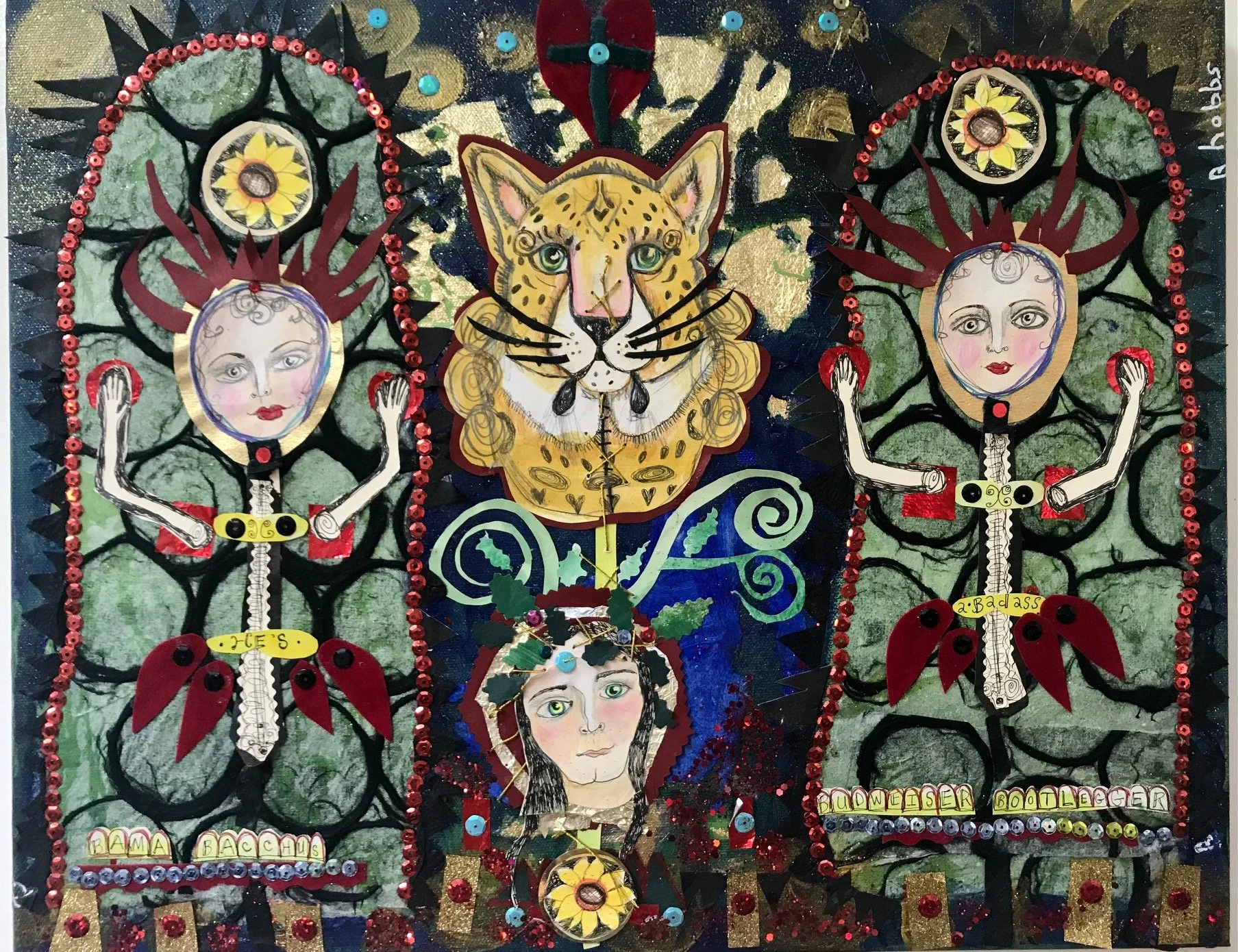
The art that appears alongside this piece is “Bacchus the Bootlegger” by BLAIR HOBBS.