
Dear Annie
Lukas Flippo
Dear Annie,
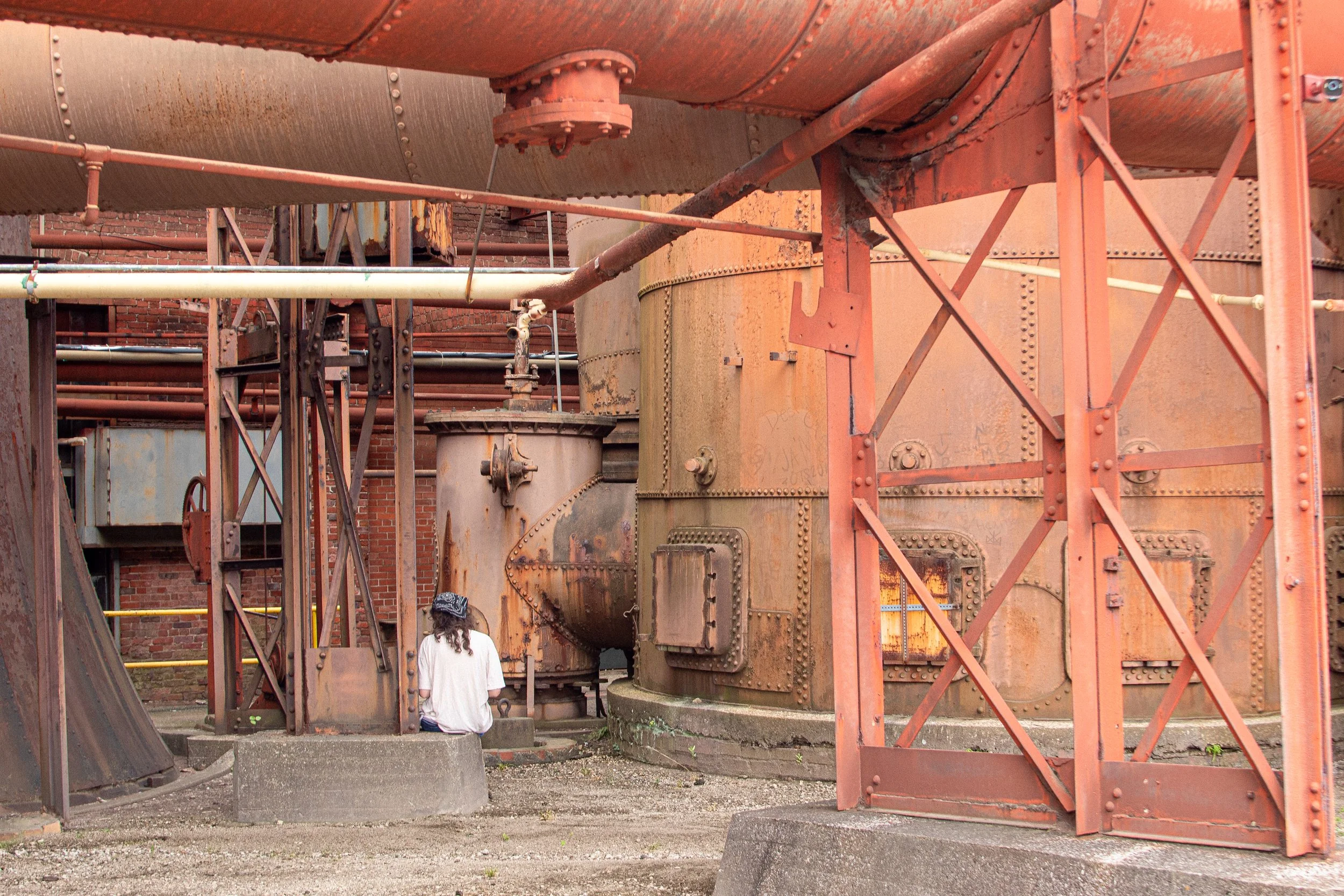
It’s dark. Real dark. I’m sitting on the cold metal grating of the catwalk that leads from my room to the center of the rig. The water’s angry tonight, it’s swirling and smashing halfway up the four orange pillars that keep us floating in the air, masters of the sea, masters of the earth, taking, taking, taking, we give it one of our own every once and awhile for forgiveness, only option is to pray it won’t be you.
On nights like these, I slip out of the bunk room, there are six of us on the third floor. I’m on the top bunk. We have a fan that spins so fast it feels like it might fly off and cut me into little pieces. I like to make bets on which blade will be the murderer, and then I follow it, my eyes racing around a NASCAR track until I doze off.
But on nights like these, it doesn’t work. I slide down the foot of the bunk quiet, so I don’t wake the guys and grab a pair of sweatpants and a windbreaker from the chest by the door. I wander out here on the deck with my earbuds shoved and twisted into my ears somewhere in that no-mans-land between not falling out and hurting, listening to Highway 61 Revisited by Bob Dylan. It’s funny, I know, there isn’t a road anywhere near here, a hundred miles from shore, but when the waters roaring real loud, it overtakes the music, and the song feels far away, like I’m a radio tower, catching far-away signals from home, or an astronaut, reading little folded up postcards from Earth, just how I dreamed it when I was a little boy.
It was not my intention to write this letter to you tonight. Truthfully, I have never written a letter out here. I had to sneak into the office to steal some loose sheets of paper and a black ink pen. I was looking up at the sky, trying to decide whether one rushing light was a plane or a comet when I noticed a fluorescent light hitting the side of black wire running alongside the upper deck.
And it took me back to the days driving to your house in Duncan. From town, it was hard to know which turn-off the highway was Sparrow Tail Lane, so I would count the telephone poles headed out of Cana. After the town limits sign on the other side of the bridge, there were eight of them before your road. As the car floated up and fell back down the hills, my headlights hit the phone lines, sending a gold light streaking across them like sideways lightning strikes. I pretended the streaks were messages, jumping from one pole to the next, traveling from sender to receiver. A boyfriend telling his new girlfriend about his day, a daughter telling her grandmother at the nursing home goodbye for the final time. And if I swerved the car off the road and smashed into one of the poles, the words would fall to the ground like a note dropped from a carrier pigeon. And if I got out of the car and walked through the grass to pick up the folded piece of paper, I would understand the words written on it, the story of Cana, the people we know, the people we love, the people we hate, the stories all the same, family to family.
I hear they are tearing all those telephone wires down. Now, our calls go to space and bounce back down, instantaneous. I like the old way, the delay between your thoughts and their thoughts. The words become a third party, a creation independent of the four lips speaking them, a little ball kept in play, being given a chance to become something all their own.
I’m sorry I didn’t give you the chance to become a woman all your own.
The image won’t ever leave my mind. Us in the living room of that cheap apartment I had on Lynwood, I was sitting on the couch in my blue work jumpsuit. That white couch with the purple and pink flowers all over it that the Ellsworths wanted rid of. Dad overheard them talking about a renovation during one of our lunches downtown at Sammy’s. He got this glimmer in his eyes, like my words were shooting straight through them and into the deep recesses of his brain, never registered and forgotten immediately. He put down his glass bottle of Coke and walked to their table. We left our burgers there on the bar. Before I knew it, I was pouring sweat backpedaling up the concrete steps to our apartment. “It’s money or labor. Everything has a price, my boy,” he said, falling onto the cushions. “Got any Cokes?” he asked. I remembered showing it to you the next day as a big surprise, covering both your eyes with my hands when we walked through the front door. “Corey, if it’s an animal I swear to God,” and then I slid my fingers away. The couch looked like the Ark of the Covenant, the late afternoon sun shooting through the living room, lifting it up like some lost jewel amidst my clutter of smashed beer cans and dirty shirts and plastering our shadows onto each cushion like a premonition. “Did you rob an elderly woman? Is she tied up in the bathtub?” you laughed and rushed through the kitchen to the bathroom and ripped back the shower curtain.
We spent so many nights together on the couch, you with your binder open to your anatomy notes, me watching the Braves on the television, sending prayers up to the crooked ‘95 championship pennant hung on the wall behind our heads. We would jockey over the volume, you needed it quiet, I wanted it loud to hear the commentary, the rocker going up and down and up and down until finally we took the remote and turned the television off and pushed your binders to the floor. I would check the final score while I cleaned up in the bathroom, you would move your notes to the circular scratched up wooden table in the kitchen and mutter about how you would have to wake up early in the morning to study more.
And you always did. I had to wake up at 5:00 to make it to whichever site in the county we were building at. I would grab two frozen waffles and pop them in the toaster and stand with a cup of water and eat mine leaned up against the counter. Yours would sit on a plate next to your books, your right hand always plastered to your forehead and your left scribbling away copies of your notes. That’s how you studied, copying your notes over and over again. You liked to sleep later on test days, your rest was more important than cramming. I put money aside for those mornings, and I woke up 30 minutes early to sit in the drive-through line at the Hardee’s to get you a sausage and egg biscuit. It would sit on the table for when you woke up. A kiss on your forehead while you still hid under the comforter, and I would be gone into the rising sun.
I still have that photo you took of me on my first day on the job, 6:30 a.m. on a July morning two months after graduation. Dad knew the Shelby’s from church, and he helped get me in for a position doing handy work for their construction company. I still had the baby-face, my feet were sinking in the dew on my parent’s front lawn, standing next to my old maroon Pontiac Trans-Am, my blue jumpsuit swallowed me whole, the sleeves were too long on either arm, the pants all bunched up over the work boots dad bought me at the military surplus store.
The print is in my wallet. It’s all torn, wrinkled and discolored from the sweat that seeps through my jeans pocket. At least once every couple months, I walk to the edge of the rig and hold it out over the cliff. I let it rest on my palm, begging for the wind to decide. Because I can’t ever make up my mind if I want it to be gone forever or buried with me in my coffin. That little boy, full of hope, fresh out of his graduation gown and ready to go get his first paycheck, unaware of how hard life would get. Do I love his innocence, or do I hate it? I turn my hand sideways and let the picture fall from my palm to hold on for dear life between my thumb and my pointer finger. If I let it go, do I lose him forever to the corpses that litter the oily ocean floor? Or do I set his soul free to nature, to wander and inhabit someone more deserving? I can’t ever decide, so there it sits, hidden behind my driver’s license and work ID.
I drove to Santell's Grocery parking lot after the argument. Through the windshield, I watched the teenagers run between their trucks, dancing, playing catch, hooting and hollering, passing a brown paper bag between them. I remember thinking how small we really were, how new kids replace us, same classrooms, same sneaking around, same types going to college, same types going to work. I tried to drown it out with the radio, but all I could hear coming through the speakers was you, the catch in your throat, “I think I want to go on to Starkville and get my bachelor’s, I want to be a nurse or maybe even a veterinarian.”
I started punching. First, the radio, until its screen was in little glass pieces all over the floorboard, wires strewn out across my knees as the unit fell out, then the dash, I pounded it and pounded it until the dent became a crater, blood poured out of my knuckles. I never saw all those teenagers staring at me. No, when I looked up, I saw you, in the cap and gown, your red lipstick, dirty blonde curls falling over your shoulders, the locket your momma gave you for your 16th birthday with a baby photo of you inside and the engraving “hold on tight to your dreams” dangling in between your breasts, your apparition faded away as your voice coming through the speakers was sucked out into the night, until you were totally gone, your voice and your body, and heaving, I realized I wasn’t your dream.
We had just gotten home from your graduation party at the grandparents’. I walked in and fell on the couch. You had to go pee. I had gone straight from work to your ceremony and the party, it had been a hard day, and there were still black smudges on my face, the ones you always rushed to rub off with a wet rag. But that time you didn’t. I grabbed the remote and turned the television to Sportscenter and was almost asleep when you walked in from the bedroom and turned it off. You said you wanted to go for it, that your daddy was skeptical of you making it through community college, that you had more you wanted in life than being an aide at the hospital, that you could get Pell Grants and work part-time at a restaurant or something like that for the next two years to help make ends meet while you got your nursing degree. You said you thought about working a couple years here in Cana and then going back, but you decided if you didn’t do it now, you would never do it.
I blew up.
About how we lived together on credit cards for the last two years, how we needed you to get a job, a full-time job, how I wanted to marry you, how I wanted to raise children with you. I told you I wouldn’t wait. I told you that if you went back to school, we were done.
After your ghost disappeared at Santell’s, I drove over to the train bridge and threw the engagement ring I had been hiding from you into the Greenslick River. My car aimlessly wandering on some country road an hour or two later, I fell asleep in a gravel inlet with the seat reclined.
The next morning, I watched from across the street as your parents helped you carry your things out of my apartment. The preacher answered the phone on the second ring as y’all pulled out of the parking lot, our mattress peeking out of your dad’s truck bed, he said it was fine to cancel the proposal. The plan was to interrupt your children’s sermon. I only told him I was holding off.
I wanted my parents’ life. So bad. To marry my high school sweetheart early, have a couple kids a couple years apart, move into a brick home by the golf course with a big yard, work my way up at the company until I was in management and didn’t have sweat it out in the dirt on sites every day, then come home and play catch with my boy, spend weekends out at the fields for tournament ball, get KFC family meals for Sunday lunch after church and sleep in the recliner while NASCAR played on the television until the evening service.
It was the fall before I saw you again. We were working a construction job in Starkville, and the boys wanted to go to Harvey’s for lunch. At the stoplight on Highway 12, I saw you pull into the parking lot and get out in a white shirt and black apron. I thought quick and convinced them to go to the Chick-Fil-A across the street instead.
A couple months later, we got dad’s test results back. It all happened fast; one day he started having trouble peeing and then by the next week it had turned into back pain and tightness in his chest. He couldn’t sleep for fear of choking, he said it felt like his lungs were closing in on him. Mom finally forced him to go see Doctor Johnson at the clinic, you remember he never got himself checked out. Mr. Johnson got worried when he explained his symptoms and sent us straight to Memphis, same day. I called off work and drove him.
Mom cried in the backseat the whole way there.
As you know now, it was prostate cancer. Stage three. It felt like a movie scene. Mom biting her nails, her puffy eyes darting around the room, at the needles, at the sterilized gloves, at the silver sink. When she made eye contact with me, she looked away fast, my hopeful, small smile was the fuse to her powder keg of tears. She lifted her hand to cup her mouth, to muffle the heaving so dad couldn’t hear. He sat there on the brown reclining bed. His shifting around made the white paper covering it crackle. He clasped his hands together on his lap, his black boots swayed back and forth above the floor. I couldn’t shake how much he looked like a little boy approaching the pulpit at the end of the church service to say his prayers. How he didn’t look like a giant anymore, how I remember when he took me to the doctor back in elementary school, I gripped his thumb with my whole hand and pursed my lips, staring up at him while the doctor injected the needle into my left arm. He said, “Don’t let them see your pain, son, never let them see you hurt.”
Stone-faced, he was silent when the doctor walked through the treatment options and talked about the life expectancy. On the way home, he asked me to pull over in Duncan to the Zion cemetery, where his father is buried. We would go there once a year, to put new flowers on the headstone and take a family photograph. When we got parked, dad would always make the same joke — “Why are there fences at cemeteries?” We would roll our eyes, knowing the punch line, we let him say it anyways. “Because people are just dying to get in.”
This time, he asked us to let him go in alone. Me and momma watched as he stood in front of the headstone, talking to it. But the whole time, he looked down to his right, where he would be buried in a plot right next to his dad.
A couple weeks ago, we had a scare here on the rig. A false memory flashed in my mind, me standing in front of their two headstones, telling them that I would be there real soon. I wonder if that’s what he told his dad.
My father’s diagnosis spread through Cana like a wildfire. In Walmart, at church, on work sites, people would come up to me to ask about him. I would always say nice, hopeful, upbeat, inoffensive things, like how mom was finally letting him wear his baseball caps inside. They would laugh, smile, whatever, you could see through it, right to that little sadness in the droop of their eye, it was a forgone conclusion to them, their approach, their questions, they were disguised condolences, “Your dad is going to die, and I am so sorry.”
It was around that time I ran into Principal Martin. You remember him from middle school? We were doing work at his house, leveling out the backyard to put in a shed. His grandson was a freshman in high school. Mr. Martin wanted him to have a batting cage to practice extra. I remember how weird that was, because when we were office aides for him that year, his grandson was little, you used to play peek-a-boo with him through Mr. Martin’s office windows, and now there I was talking to him about his curveball while we took dinner breaks. I know he went and played college ball for two years at Alacola Community College, but I lost track of how it all ended up. Mr. Martin had a son working offshore and told me I ought to give him a call, the money’s good and he knew I could use it. Frankly, I would have done about anything to be out of Cana. I know that sounds awful with dad being sick, but it didn’t feel like there was much I could do for them. He had this sort-of never-ending tough guy mantra, and the more he could pretend nothing was wrong, the better. He called me and mom “Mopey and Dopey,” and made fun of our sad faces and hushed tones. And after I left, when his prognosis kept getting better, he used that as evidence I should stay away. I work a 14/21, which means I’m out on the rig for 14 days, nonstop working, then I’m off for 21. Until dad’s state really took a downturn a couple months ago, for years I have been spending one week off in Cana.
It’s weird. My bedroom’s frozen in time, mom never would throw anything away, and I feel like a giant inside it. Every night I can’t sleep, I stare at the popcorn ceiling, my feet hang off the end of the twin bed. Sometimes, a car drives by and its headlights cut through the blinds and light up the Spiderman Fathead on the closet. Usually around 3, I climb out of bed and pace back and forth on the concrete, you remember we ripped up the brown carpet during my senior year of high school but never got around to replacing it, tossing the baseball from my senior night ceremony up and down, the little black marker on it with the date got a little smudged by my sweaty hands. The snow globe you gave me, the one with our picture outside the school, right after I had asked you to prom, still sits on my desk, next to that skull we made out of sugar for Spanish sophomore year, your paint-job still holds up well, apparently Mrs. Jimenez never found out you did mine, she told momma years later how shocked she was at my painting ability and that I should consider painting houses for a living.
For the last eight years, that’s what my life has been like. I work like hell for 14 days, barely sleeping, go sit in the mausoleum of my youth for a week, and then come back and eat pizza and watch television in my apartment for two more weeks. And then repeat it. I’ve mostly stayed alone through it all, I would go on dates, but nothing ever really stuck, none of them met momma or daddy. She didn’t like that all too much, momma that is, she is always trying to set me up with someone. Usually, it’s one of the students or recent graduates interning at the hospital. I guess I should settle down, but I really don’t see much of a point in it.
I’m writing this big letter to apologize for last week, I hope that’s okay. How I didn’t say hello at the visitation. Truth be told, I was standing there, next to daddy’s casket, and I saw you walking toward the sanctuary from the parking lot through the window, you and your husband and your little girl, and I got nervous, having not talked to you all these years, I ran straight to the bathroom, I think I completely blew off an old lady trying to tell me how much she loved daddy. I hid in a stall for what felt like an eternity, to make sure y’all would have left by then.
And then at the funeral, I kept my eyes down when we all walked in from the back of the room to the front row. I know you probably weren’t looking at me, but for the whole service I could feel your eyes shooting through the back of my head. I felt, and I still feel, ashamed. Ashamed that I couldn’t face you, ashamed that I said no to your dream.
Mom got me your address from the church directory to send this to…The Acres? Wow, you really made it happen. She told me your husband is a doctor in Tupelo, that she ran into you while she was picking up lunch one Sunday and your daughter was big into softball. I know if she is halfway as competitive as you, she is going to be a problem.
I didn’t mean to write anything crazy here, but next time I’m back in Cana, I would love to maybe get coffee if you would be open to it? It’s completely okay if you are too busy or don’t think you are ready for that, but I would really love to hear how everything has gone and fully apologize in person or I guess make-up for dodging your well-wishes at the service. I don’t know if he ever got to tell you, but my dad loved you with all his heart. When the cancer spread to his brain and he stopped remembering things, he would ask me where you were every time I visited the hospital. Thank you for being kind to both of them, I know he would want you to know that.
All the best,
Corey
LUKAS FLIPPO is a writer and photographer from rural Northeast Mississippi. He graduated from Yale University with a degree in American Studies and Journalism. His multimedia journalism has been published in the New York Times, The Washington Post, and TIME Magazine, and his photographs have been recognized by the White House News Photographers' Association and exhibited in museums across the United States. His storytelling centers around rural memory, and what it means to leave it behind. His fiction writing and poetry have been published in Deep South Magazine, Down in the Dirt, and These Fifty States.
The art that appears alongside this piece is by SELA RICKETTS.