
Irma and the Grand Finale
Dustin M. Hoffmann
LaToya Watkins selected “Irma and the Grand Finale” as the winner of the 2026 Barry Hannah Prize in Fiction. Of the story, Philyaw writes: “This piece stood out for its sharp, vivid prose and the emotional complexity pulsing beneath its humor and tension. The story captures, with real punch, the ache of growing up while watching a parent struggle and change before your eyes. What makes it especially memorable is the way its larger themes—class, loss, pride, and love—emerge so naturally through the beautifully observed moments between Irma and her father.”
Irma didn’t even really want to see the fireworks, but she couldn’t tell her father, not after they’d driven thirty-three minutes from their tiny apartment in Gastonia to their former hometown of Tega Cay, South Carolina. What could she say once he finally landed a parking spot miles from the golf club and was leading her down the blackened path toward the crackles and whomps? When the canopy of trees parted now and then, they could see a billow of gunpowder flashing pink or green. But they were still too far to see the fireworks, the show she and he had watched annually since she was born. Losing their Tega Cay house wasn’t going to stop her dad from forcing the ritual, and she’d been dragged along.
“Just a little closer.” He gripped her hand, pulling her at a rapid walk. “We gotta step fast, Irmy Wormy.”
He’d called her that as long as she could remember. She was an expert at baiting hooks when they’d fished the private-access lake. Other girls, they’d barf at just the thought of touching a worm, but Irma could tear their gelatinous bodies in half and lace them onto a hook. The secret was pretending they were nothing but fat noodles. Forget that those writhing guts connected to many tiny hearts. But she was thirteen now, and Dad’s nickname felt ugly and childish. She still hadn’t figured out how to tell him she preferred her full name, or how to tell him the fireworks didn’t matter. The things she couldn’t tell her dad stacked up these days, but that was probably just what growing up meant.
Irma’s feet squished on something as oozy as a dog’s shit. She tried to use her phone to light it, but the battery died on her. She’d used it up on the car ride playing Roblox with strangers. None of her old friends from Tega Cay played anymore, so even online, she spent her time alone. At least the game kept her mind busy enough to avoid thinking—about the kids at her new school who avoided her, about her mom and dad’s nightly mumbling, about how she had to hear everything because of their thin-walled apartment, and her room didn’t even have a window and was probably technically a closet.
“No time for dawdling, Wormy, or we’ll never make it,” her dad hollered.
She jogged to catch up to his flashlight bouncing through the trees. She wanted to check the bottom of her shoe, but his pace rushed them onward.
“If we still had the golf cart, we’d already be there. The whole sky would be exploding over our heads like we love,” her dad rambled as they marched on. He’d sold his BMW in October, his golf cart in November, but that didn’t stop losing the house. The man who bought the golf cart looked younger than her dad. A sculpted beard decorated his face, and he stood in neon-orange running shoes that seemed designed for astronauts. Her dad had worn his work loafers under cutoff shorts. He’d told her they’d be that much healthier walking to school rather than planting their fattening rumps on the cushy seats. But riding the cart had made her feel fancy as the golfers who visited their peninsula town. Her dad had never played golf.
“Wanna ride my shoulders for a while?” he asked. “If you’re getting tired, that is.”
“That’s okay,” she said. Josh Grassley had called her a chunky worm in social studies, and then at lunch she pitched her apple at his groin, which landed her, not him, in detention. Her dad, though, had thinned since he lost his job at the bank. It wasn’t that he was jogging or dieting like the other dads. It seemed like his dropped weight magically transferred from his rail body to hers.
“Well, we gotta make up some time or we’ll miss everything.”
“We could cut through,” Irma said as they passed another putting green just yards from the trail. She’d always wanted to walk on the town’s best manicured lawns guarded everywhere by NO TRESPASSING signs.
“That’s illegal, Worma.” His flashlight brushed over the ragged pine straw bordering the golf green like a moat. “And I like your plan. Watch out for copperheads.”
Before she could second-guess her suggestion, he clutched her hand. They slid down the slope until their feet found the plush sod. She’d grown up envying the middle-aged white men wearing pastels and baseball caps who tramped all over the sacred greens. She’d abided by the trespassing signs after recurring nightmares of being crammed inside a prison cell, getting worms tattooed on her neck by her toothless bunkmate. Sure, in waking life, the officers smiled at her on the weekly “Coffee with Cops” walk to school. But they all carried guns, right there on their belts.
Her dad’s arm swung her shoulder around, and he hissed, “Look at that, Irma.” A tentacled shower of golden sparks sprayed across the night like the fronds on a palmetto tree. It must’ve been launched by some stranger whose house lined the golf green. She bet the golf balls knocked against their siding all day.
Another flash erupted, this one from the other side of the green. Then a third. The sky glittered all around them. Her butt dropped to the putting green’s sod that felt soft as a mattress. A few days ago, she’d tagged along with her dad to one of those fireworks tents in a grocery store parking lot. He’d aimed to buy some, but the big ones, the good ones, a box called “Whoa Baby!” cost sixty bucks. His face had fallen. Ridiculous to fork over four hours of Mom’s work for ten seconds of fire in the sky, he’d said later in the car. They’d go see their old city’s show for free instead. It would be like visiting an old friend.
All these people burning their cash in foolish flashes was such a stupid waste, and that made the show all the sweeter to Irma. At home, they’d had to skip her mom’s recipe for Irma’s favorite chicken wings because they were too expensive. They’d had hot dogs that gave her a headache.
“What’re you sitting for, Irmy Wormy? We gotta hustle.”
“But look, Dad,” she said.
His head tilted up, his chin angular against the blinking night, his neck narrower than she remembered. He was becoming a stranger, which was probably the same case for her to him. She’d grown two inches and fifteen pounds last year, cut her hair short to her chin after a childhood of letting it grow down her back. They were two strangers who had always known each loitering on the putting green.
“Coming at us from all sides,” he said.
“It’s pretty,” she said.
“Like a war.”
“Like ‘rockets red glare, bombs bursting in air.’”
“That’s it exactly, Irmy.”
They watched together for a few more flares, white, yellow, red, green. Then a voice bellowed. If the voice belonged to the cops, she didn’t want to see her dad’s head pinned against a cruiser hood. Maybe they’d press her head, too. She was grown enough now. She snatched her dad’s hand and pulled him toward the tree line.
“Find a shortcut?” he said as they rushed through the shrubs and slumbering snakes.
They spilled out onto someone’s lawn. A long fence interrupted their path.
“This is someone’s yard, Wormy. Someone could have a gun and be drunk and not-so-neighborly.”
“Then hurry up,” she told him. She felt like a secret agent, like a soldier, and that was patriotic maybe. They hopped a fence and hugged someone’s siding as they coiled around the house. In the front yard, a huddle of shadowy figures congregated in the cul-de-sac, backlit by a fountain of spraying sparks. The fiery fountain transitioned into spitting crackles and then a series of whistles so high-pitched she felt her ears tightening. Then silence.
Her dad clapped from the curb, gave a hoot. The shadow people turned their bodies, though it wasn’t light enough to see their expressions, to see if they were mean, to see if they wore handguns clipped to their hips.
“Where’d y’all come from?” one of them said.
“Good show, brother,” Irma’s dad said.
“That one cost thirty bucks. Wanna chip in?”
Her dad laughed. The shadowed neighbors stiffened into statues. It felt like a scene in one of the old western movies her dad watched during the hours when he used to be working. Irma reached into her pocket, fingered the crinkle of five-dollar bills, her last fifteen bucks from babysitting. She held it out to the stranger, but her dad lowered her arm. One shadow stepped nearer, and she could almost see his face.
“This one cost fifty,” another voice from the shadowy huddle cried out, just as an ember screamed skyward and then blossomed into a red umbrella of sparks. When the shadowy neighbor turned their back on them to watch, Irma tugged her dad’s hand, fleeing with him down the cul-de-sac’s road. Voices chirruped and yipped, hands clapping slow and loud. They could be pointing anything at their backs, any loud explosion to ward them off like they were coyotes. But Irma and her dad were bald eagles, swooping through the night, even though Irma wasn’t sure which way the big show was. All she really wanted was to go home, but she wasn’t sure about that direction either. She was crummy at leading, and why should she have to bother with that? She was still a kid, kind of. She wished she could go back to being that. She let her dad’s hand drop, slowed her gait.
He resumed his hustle, stepping ahead of her. “Do you wish we still lived here, Irmy?”
“Next to a bunch of weirdos? No thanks.”
They used to swim at the private beach in the summers. She used to have a bunch of friends at the school. She’d ride on their pontoons, and they’d sleep over at her house in the big den, a room for nothing besides a couch, a fireplace, and a piano no one played. She missed braiding Sarah’s silky hair at midnight, missed Karly’s braces looking like treasure in her smile. She missed the way her school smelled like nothing—that scent of new bricks and bright tiles and fresh books. Her school now smelled like wet towels left in the sun.
“Screw this place,” she said, “and all these rich assholes.”
“Language, Irma,” her dad said. He kept striding forward. The trees parted and the sky opened over the boulevard. A cloud glowed murky green, followed by a sallow yellow. The explosions were thumping louder. Not enough to feel it in her chest, but just enough to tickle her eardrums. It seemed they’d been walking for hours. Surely the city’s show would end soon, and then they could leave and never come back to recall the foreign life she used to live.
Her footing slipped, and she crashed onto a knee, caught the paved path in her palms. Her skin stung, though she refused to let herself cry. She hadn’t cried since her dad first announced the move. He was barely visible in the blackened path ahead. He was going to disappear. She’d have to sprint blindly. Terror welled from her aching knee that was surely pouring blood. She called out to him. “Dad, don’t leave!”
And he probably couldn’t hear her, so determined in his path toward the thudding fireworks, his own heart throbbing in his ears. She reached for her phone instinctively—the glow could numb her—but it was dead and dark. Everything was. A hot hand touched her sweaty shoulder.
“You’re okay, baby.” It was her dad’s voice, solid as when they called Tega Cay home and imagined they would forever, back when she was little and stupid.
“I slipped,” she said. “Think it was dog shit. These jerks can’t clean up after themselves.”
“Let me see.” His flashlight paled the world around her. He used his shirt to brush gravel out of her palm. His care burned, but then he blew cool air on her skin. The light flashed over her battered knee, only red and raised, and she had the urge to say something about how grateful she was that he’d worked so hard for so many years, and it wasn’t his fault some assface fired him. How could it be her smart, gentle daddy’s fault?
“Irmy Wormy strikes again!” her dad shouted.
“What?”
“You called your creepy crawlies from the sky.” He laughed like a punch in the dark. “Worms and worms and worms. Everywhere you look, Irmy.”
“Why won’t you just shut up?”
“Hey. Whoa.” His phone’s flashlight brushed over the paved path. “Look at what you slipped in.”
His light settled on a flash of slick goo. It wasn’t dog shit. It was viscous like snot, a globular mass in the center, like a broken egg with a gray yolk.
“What is it?”
“Great big gooey-ooey slugs. Leopard slugs,” he said, brushing his light around them where their slick bodies flickered. “They must be falling from the trees.”
She felt like puking. These slugs had climbed the trees for hours, days, giant chunks of their lives, just to what? Fall to their deaths? Her knee and palm surged, but she wouldn’t cry in front of her dad who did plenty of that, his whimpers exposed by the tiny apartment in Gastonia. Some nights she wanted to hug him. Other nights she wanted to burst out of her room and tell him he was a loser and he’d lost their house and all her friends and all she loved, and she’d slap him and slap him. But most nights she just stared at her screen’s blue glow against the popcorn ceiling, vowing she’d never cry like her dad. She’d get a job that paid mountains of money and be so good at it that no one could ever get rid of essential Irma. No one would ever dare compare her to a worm.
A cacophony machinegunned ahead of them. She awaited the pause between explosions, but the thunder crackled unceasingly.
“It’s the end, Irmy. We gotta book it,” her dad shouted. “And watch out for those squirmy friends of yours.”
So, Irma ran, surely squishing more slimy bodies. She kept pace with her dad, his excitement contagious. Then she overtook him at a full sprint. His flashlight cast her body onto the ground, a long shadow splitting the difference between father and fireworks, their eruptions growing brighter and louder. At the top of the hill, she could finally see the sparks and not just their blur through smoke. They blazed behind a wall of narrow trees, the trunks striping one thousand fires. They could’ve been prison-cell bars, this last barrier between Irma and her hometown’s fireworks show, which they’d now officially missed. She didn’t care. She’d never cared. Fireworks were for little kids and drunk adults who had so much extra money that they wanted to burn it in the sky. Every city in America was burning money over the ramparts. They were saying to each other, to themselves: this is America, land of the free. But nothing would ever be free for Irma. She already knew what her dad wouldn’t admit—there was no going back to what was already lost.
The sky just kept splitting into bright blooms. Her knee throbbed, reminding her of its raw sting that would soon enough harden into scab. An arm wrapped her sweaty back. His lips fell upon the crown of her head. But she wouldn’t turn to him. She wished her dad would stop holding onto her and recognize that America was blasting its sky apart. Only silence and wafting gunpowder could remain after the crowd quit their cheering and fumbled for home in the dark.
DUSTIN M. HOFFMANN is the author of the story collections One-Hundred-Knuckled Fist (winner of the 2015 Prairie Schooner Book Prize), No Good for Digging, and, most recently, Such a Good Man. He painted houses for ten years in Michigan and now teaches creative writing at Southern Illinois University Carbondale. His stories have appeared in New Ohio Review, Gulf Coast, Ninth Letter, Alaska Quarterly Review, and One Story. You can visit his site here: dustinmhoffman.com
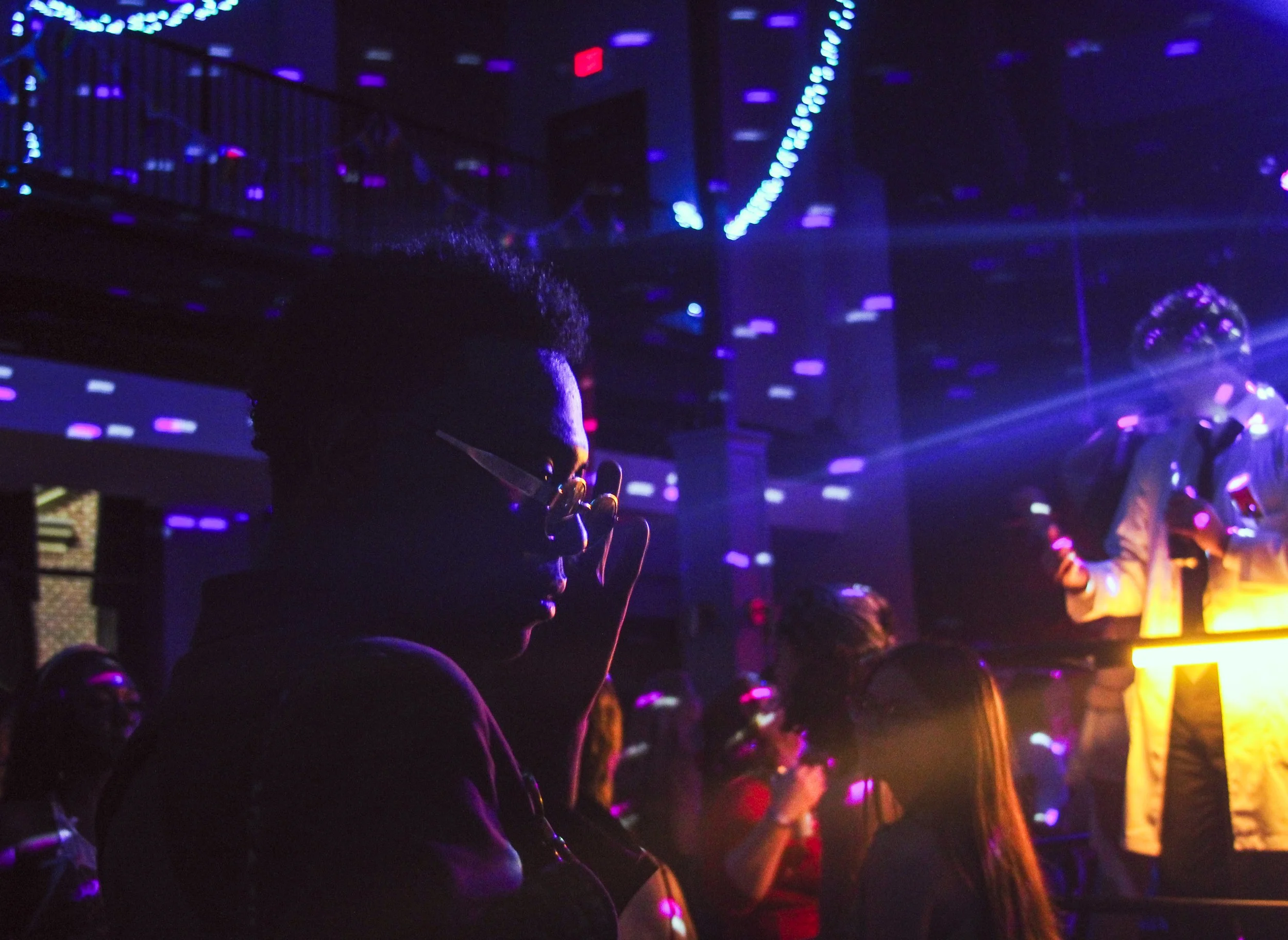
The art that appears alongside this piece is by SELA RICKETTS.