
AN ATMOSPHERE OF
DOUBT: A Conversation
with Rachel Kushner
Sarah Ligon
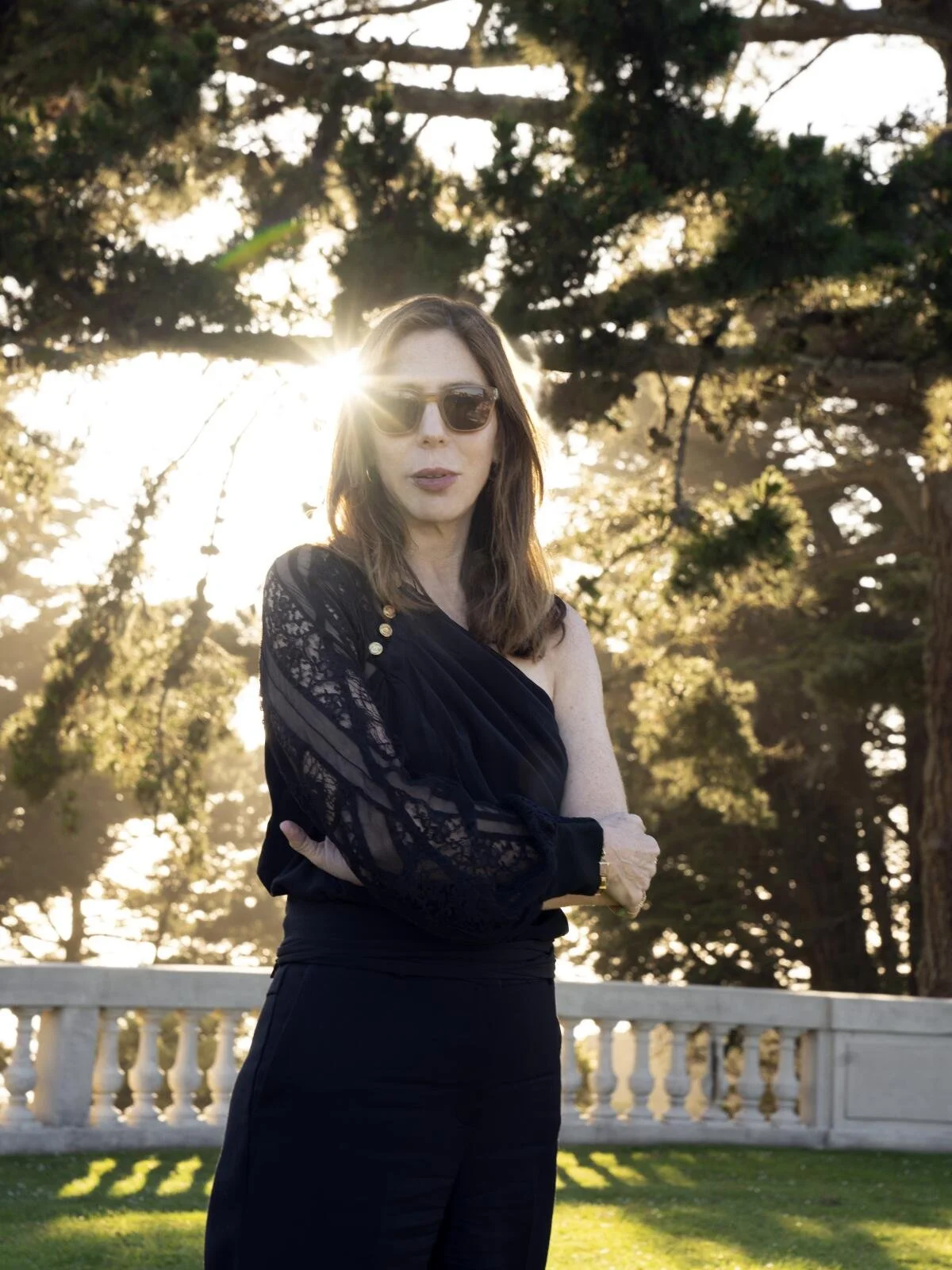
I spent last summer in bed with Rachel Kushner. With her novels to be precise. And her essays. And that voice.
Sick and confined to my bed for several days, I decided to begin preparing for this interview by listening to her latest novel, Creation Lake (2024), on audiobook. Hooked from the opening line—“Neanderthals were prone to depression, he said,”—I quickly hopscotched my way backward in time, through her collected essays, The Hard Crowd (2021), and two previous novels The Mars Room (2018) and The Flamethrowers (2013). Kushner reads them all herself, and I was entranced not only by her soft, girlish voice but by her wide-ranging intellect and her ability to traverse subjects, eras, and genres. Kushner wrestles hard with hard topics, from Palestinian refugee camps to the American prison-industrial complex, to the origins of our species, yet she also writes, with a fan’s depth of knowledge, about art, cinema, and vintage cars.
Reading her collected works was also an education in fiction: especially, in what an author can get away with. Kushner is a writer who can gets away with it all. In Creation Lake she pushes the limits of point of view, layers on short mosaic chapters, and employs abrupt em-dash endings. Here, and in other work, she weaves a thick tapestry of seemingly unrelated cultural artifacts that just hang well together, from an obscure 1980s Italian documentary about a nine-year-old lothario to a riff on Polynesian wayfinding.
Born in 1968, Kushner was raised by beatnik, scientist parents in Eugene, Oregon. She came of age in the rock clubs of 1980s San Francisco and earned a BA in political science from UC Berkley, before completing an MFA at Columbia University, where she studied with the novelist Jonathan Franzen (Don DeLillo is another mentor). She has won numerous literary prizes, including the Prix Médici, and was a twice a finalist for both the Booker Prize and the National Book Award.
Kushner and I spoke on a hot and humid September morning on the University of Mississippi campus, where she was due to give public lecture later that evening. In our interview, transcribed here, edited and condensed, she talks about her sources of inspiration, the long arc of her career, and her feelings on the end of the world.
*
SL: I’ve read a lot of your nonfiction, and you’ve written on a remarkable variety of subjects, from long-distance motorbike races to a Palestinian refugee camp and personal style to the abolition of the carceral state. I’m curious, what’s one subject that you haven’t written about, but that you’d like to?
RK: I just pitched an assignment and signed a contract to cover the federal death penalty case against Luigi Mangione. Part of the reason I’m interested in that case is because many aspects of where we are right now are kind of inscrutable to me, but the acts that he committed are not inscrutable to me. Without wanting to show my hand too much, I think that he made people understand, in a pretty instinctive, basic way, that there are different kinds of violence in this country, and that a lot of people have been screwed over by the insurance industry.
Also the Trump administration wants to push through the federal case while Trump is in office. There hasn’t been a [federal death penalty] case tried [in New York] since, I think 2007, so the whole thing just has a lot of significance to it. Also, trials themselves have something to do with all of us, in part because of the theatrical component. Like, why is that part of the experience of somebody who makes a terrible decision to commit an act of violence, that they be tried by a jury and before the theater of anyone who wants to enter the courtroom and watch the proceedings? That is really fascinating to me and I want to have this experience where I just put everything in my own life on hold and go to this trial every single day and immerse myself in that environment because I feel like it will give me a better read than I have right now on who we are—the whole spectacle of it.
SL: And I’m curious what makes you decide to write about a subject in nonfiction versus fiction. Then sometimes you write about the same subject—the U.S. prison system, say—in both genres. What guides your choice.
RK: That’s a good question. It does seem to be pretty clear to me. Like, I never have to decide as though there’s the territory of fiction over here and nonfiction over here, and I’m deciding which container it goes in. That’s never happened to me. It’s much more like the thing presents itself as one or as the other. Novels are a big pursuit for me, and it seems to be the case that it takes me five years, basically, to write one—not that I’m on my treadmill, writing the novel, that whole five years, but that’s the sort of like the genesis takes about that long and I decide usually pretty quickly when I’m going write a novel about [something].
It starts with some kind of image and then I just go with it. I never think, “Oh, would this be better as non-fiction?” And I’ve never once decided to write a novel and then change my mind and written about something else. It’s like the thing that you choose to do, it’s almost a red herring because the novel itself will emerge from something much deeper and more unconscious and is also a sorting mechanism for how I live, how I proceed through the world, what I see.
Until The Mars Room, I had not written a contemporary novel. I mean, I don’t consider my other works to be historical fiction. Maybe that’s a semantic thing and also a kind of snobbery because I feel like historical fiction is sort of a degraded genre, and I wasn’t really interested in history. I was interested in the experiences that I’d had reading fiction that felt very alive and that also further illuminated things that had taken place, like Blood Meridian by Cormac McCarthy.
So I’ve written a novel that took place in the ’50s in Cuba, and then I’ve written a novel that takes place in New York City in the ’70s, which for me didn’t feel historical at all because I’m from the ’70s. I was alive and a child and the people in the book are adults, but it was a time that I remember. I didn’t need to look at clothing advertisements from the ’70s. I wore those clothes, you know?
But by the mid-aughts, when the journal n+1 got started, there was a lot of talk about holding a mirror to the contemporary and having something to say about your own time, which isn’t to say that I made my decision about what to focus on in fiction based on what other people think is fashionable, but I think there’s a reason why people are interested in the contemporary and part of it is at least for me, in my hands, it is harder because I still want the book to have a sense of historical resonance. The present is also history. We just don’t have hindsight on it yet.
“I realized that if I didn’t write this book, those people would never appear in any book. That’s part of what you do is memorialize and also put into art what should be there, but otherwise might not, unless you do it.”
I love to be in the hands of a writer who I feel has some sense of the warp and the weft [of a time period]. Nabokov is really good at that. I know that it’s a controversial book, but Lolita is the first novel of the motor inn. Nefarious things can take place at motels because there’s no clerk in the lobby. There’s no one watching who comes and goes. It’s a very American sort of savage anonymity. There’s little things in Nabokov that give this mid-century American texture. He was writing about the time that he was living through.
So when I write, I think, “Well, what’s the contemporary for me?” I didn’t move to California until I was 10, but a key period of my life and imprinting took place there in junior high and high school, and then I went to college just across the Bay, at Berkeley, then I moved back to San Francisco, and grew up with some people who ended up in the carceral system, and it just happens to map with the moment when the carceral system there vastly expanded. These things mark you in an emotional way, and not an intellectual—or God forbid, a political way. Which isn’t to say that I’m not a political person, but my attachment to that subject was somehow deeper. I was just thinking about what’s the contemporary for me?
I live in LA—I also happen to live walking distance from an enormous criminal court complex and a huge jail complex—and when I drive to San Francisco to visit my family, I pass through the Central Valley, and there are these lights in the middle of industrial agriculture that are on all the time, and that’s the people who are serving very long sentences in the prisons there. I know people who have been disappeared into this internal world. So I embarked on this novel [The Mars Room] that’s about that but then it’s also about the people who grew up in my neighborhood in San Francisco. I gave the main character a past that’s very familiar to me because she’s from my neighborhood, and her friends in the novel are basically the kids I grew up with. I realized that if I didn’t write this book, those people would never appear in any book. That’s part of what you do is memorialize and also put into art what should be there, but otherwise might not, unless you do it.
“In fiction, I’m not interested in trying to teach people things. I stay in an atmosphere of doubt. It’s much more interesting to me.”
Then writing about Ruth Wilson Gilmore and the prison abolition movement and the black radical tradition and these things that I put into that essay that you mentioned, I did that after I finished writing The Mars Room. It seemed like a place where I could think in a much more analytical way about this question of why was there this expansion at this particular time and who did it affect? Was this history inevitable or could it have gone a different way? And it was just a really different undertaking entirely from writing the novel. It very cleanly separated the two. In fiction, I’m not interested in trying to teach people things. I stay in an atmosphere of doubt. It’s much more interesting to me. And the voice changes a lot.
SL: Do you feel like you’re moving between different modes as you’re writing fiction versus nonfiction?
RK: Part of that nonfiction voice, honestly, is writing for the New York Times Magazine, and they have a voice. Honestly, I think they have too much of a voice. Maybe it’s not a voice. They have a structure, and they want the story to start in the middle, and then you back up. With that piece in particular, I was totally committed to humbly submitting myself to their editorial process because before they would publish that piece, they needed to be completely on board with everything in it. It was not an opinion piece where they just let you have your say and then people can fight it out in the comments section of the New York Times. The New York Times Magazine is effectively sanctioning every single line you write, and so it was a two-year process of having very intense conversations with the editors. They would say things like, what about violent crime? And then they would ask me to look at the statistics and talk to a historian in Texas. For that type of story, which I don’t do very often, I felt that I wanted to trust their instincts because they know their readership. And it very quickly became apparent to me that what I maybe had written as a first draft would have been just reinforcing who I am to the people who already read me.
SL: And what came out was something very different?
RK: Very different, in terms of having people be given the respect and the room to draw their own conclusions, and I think that it just turned out to be much more convincing because it wasn’t speaking to people who were already in agreement over something.
It was slightly similar with the piece that I wrote for them on Shuafat Refugee Camp, which is technically inside of Israel. With that, they weren’t involved in the process of writing it. I wrote the piece to be in an anthology, but they wanted to have the option to publish it, so I sent it to them, and they just had me restructure the story so that it started in the middle and didn’t share the detail that Baha, my host, was murdered until the very end. That was a very effective structure.
SL: It was a brutal and shocking ending.
RK: Yes, and I remember thinking that if I was going to weigh in on a highly contested subject matter, it was important to me to keep the reader close and make them feel like regardless of what they bring to the subject matter based on their history or their own experiences, if they were dropped into that camp like I was, and saw the things that I saw, they might have similar feelings. I tried to let the facts themselves tell the story. I sometimes will read things where it’s very obvious what the politics of the writer is, but that can be less convincing if you’re interested in bringing people into your work and having them face themselves and a subject. I’m not interested in polemical writing at all.
SL: Considering your writing as a whole, I wonder how you see the trajectory of your own work. Do you have a narrative arc for where you want to go from book to book or is it always a surprise every time?
I’m sure there are deeper connections. For better and worse, we each return to the “scenes of the crimes,” as it were, whatever they are. There’s this circularity in return. But I don’t map those patterns myself.
When Creation Lake came out, I had a conversation in Seattle for my public event there with this writer, Phil Neal, and he said, “I read all your novels to prepare for this, and I noticed that you’re kind of slouching toward the present. You start in the ’50s and then you move to the ’70s and then you’re in the ’90s and then you’re in the aughts. And chronology is a pretty boring answer to your question, but nonetheless, that pattern is there.
I guess it could be undercut by whatever I do next. Like, would I ever write in the speculative future? I doubt it, and I have a reason why, and maybe this is an unfair judgment on speculative fiction, but I feel that there’s something rather prim about speculative fiction, because its organizing principle is [to serve] as a warning, and I’m not interested in warning people, because I don’t know enough to warn them.
SL: And you don’t like polemics.
RK: That’s another reason, but it’s like it’s deeper, because the one who warns presents themselves as the subject who is supposed to know, and I don’t know. Although I think there are people who have second sight, but it’s usually not the people who write speculative fiction. It’s Don Dellilo. His writing always has some predictive quality to it where he’ll put something in a novel and then that actual thing comes to pass. I think that there are people who can see the glint of this future in the now and they do have genuine second sight. I’ve had it like once or twice, but not, I don’t think that that’s generally my gift.
The people who think they know about the future enough to speculate on its dystopic angles trust their moral judgment: that they know the difference between right and wrong and that they can recognize how other people are going wrong. I’m not interested in looking at life that way. I’m more of an optimist, and I’m just so curious about people. Also, anyone can see it now: the end is nigh.
SL: As someone who’s read a lot of your work, I see a preoccupation with revolutionaries, and I wonder why that is.
RK: Other people have asked me that, and I don’t know the answer. I seldom wake up and think about revolutionaries. I am interested in the ways that people are anarchic and unique. I was born in 1968, and I was raised by unconventional people. As a child of the 20th century, I was just aware of politics. Reagan became president in 1980, and I remember the night that he was elected. That was really the beginning of neoliberalism and Margaret Thatcher and what these English bands had to say about austerity and fashion in London. And the United States still seemed to have such a hold on Latin America. Honestly, the larger forces of history and the way they shape individual people’s lives is a part of the story.
So I don’t actually agree that I’m preoccupied with revolutionaries, because Telex from Cuba is really about the Old World [in Cuba before the Revolution] and children growing up under the aegis of the United Fruit Company, which was like the government, the postal service, the telephone company, the grocery store, the educational system, and the engineers who build the roads. That’s just a particular world, and I had access to recreating it because my mother grew up in that environment. There happened to have been a revolution in Cuba and that Old World was erased. That makes it even that much more pressing for somebody to tell that story. Because the adults who lived through that time were my grandparents’ generation, who were in their 80s and 90s, and nobody had told that story.
So I went back to the nickel mining town, the former American quasi-colony where my mom and her three sisters had lived with my grandparents, and no Americans had ever returned there after the Revolution. No one came back. The people who lived there were people of my mom’s generation, and they all grew up speaking English. They’d lived in an American town. They went to an American school, and they’d been excited to sing “Rudolph the Red Nosed Reindeer.” Yet, they hadn’t spoken English in 50 years.
So am I interested in revolution? No, I just recognized an opportunity to explore something that, to me, suddenly had the scope of a novel to it, whereas previous to that, I was writing short stories. It never occurred to me to write a novel. I just didn’t have the confidence, and I didn’t see what subject would invite me to look at characters and things from various angles in order to produce this faceted reality that could constitute a whole.
Then, with The Flamethrowers, I’d lived in New York City, I knew a lot about the art world because I wrote about art and hung out with artists. And a lot of those people were older and had moved to New York City in the 1970s when it was a place where you could get off a Greyhound bus and find a job and a cheap place to live in a studio.
Then I met some people in Italy who knew a lot about the “Movement of ’77,” as it's called, and I didn’t know anything about that. And I felt that it was so interesting that this was all going on at the same time as this much more conceptual thing in New York City, that’s really not political at all. And what if I just put the two in a book and didn’t try to marry them together—simply put them together because they were happening at the same time? It was more about questioning some things I’d always been curious about, such as Futurism and technology and art and the avant garde and violence. It was just a lot of things that I care about. It wasn’t about revolution.
SL: Yet there is another revolutionary group in Creation Lake. How do you explain away that?
RK: Well, I spend every summer [in the southwest of France], and my son went to a sleepaway camp every summer that was run by these French country people who were also kind of hippies, though not political, really. The guy who runs it is a caving expert, and then my son worked at that camp for two years, guiding children into caves where they go three kilometers underground, wading through neck-deep water. So I had access through him to the underground world of this region where I set the book. I call it the Guyenne.
I’m interested in the natural world. I am a nature girl on some level. I’m originally from Eugene, Oregon, and I spend a lot of time in nature, and in France, you can feel in the countryside that it’s a different reality and there are different streams in history that people are in communication with. Up through World War II, a third of French people made their living as farmers. Now it’s less than two percent. Like the book, I’m interested in the struggles of the dairy farmers there, and the kind of contradictions between what a young intellectual leftist would think is good for farmers and what farmers actually want. In France, there’s a ravissement with the natural world there, which I know intimately. So the book was an occasion to depict that landscape, but it’s very charged because it’s being described by this brutish woman who is not interested in nature and is being accompanied through it by her weird addiction to the correspondence written by this guy Bruno, who’s kind of more like the “me” of the book.
SL: I’m really interested in the point-of-view choice you made in Creation Lake. How did you decide that this major character, Bruno, would come to the reader entirely through his emails as they were being read by Sadie, someone who, like you said, doesn’t feel much affinity with his worldview. It’s a very unusual choice—a bold choice—and a difficult one to have to keep making for a whole novel. And yet it works because it shows us how Bruno’s worldview—his ravissement with nature and his interest into humans’ deep past— is working its way into Sadie’s consciousness and subtly changing her.
RK: You know, it’s not for everybody, but art is not for everybody, which isn’t to presume that my book is art, but I really do think it’s not for everybody. There are risks involved. But sometimes the only way forward is through the risk.
I had the setting. I had the commune, because I am connected to, or used to be connected to, a commune that was raided by the French police. And I always thought, oh, that would make a good novel, and then I got the idea for the mentor, Bruno, who’s maybe very, ever so slightly based on a real person. I just felt right from beginning, like, I get this guy Bruno and why he has retreated and why he’s a bit defensive in saying he’s not a primitivist. He’s looking for a way forward. He’s looking at the future but trying to sift the clues of the past to see if we can get ourselves out of the predicament, if we can get out of “the driverless car that is heading off the cliff.”
So, I had these different aspects, but what I didn’t have was a witness, a narrator, a protagonist, and on instinct, I thought she was going to be an American woman, but I just couldn’t crack it. That is part of the challenge of writing fiction. It can be years of not getting any lift to your craft, your aircraft. I started over one day, and I wrote the first two sentences that are the first two sentences of the book: “Neanderthals were prone to depression, he said.” And I thought, “he said”? So someone else is interpreting Bruno? And then I thought, “Yes, that’s what it is.”… He. Who is this he? And it becomes kind of incantatory. I really like the formal trickiness of it: the narrator telling you what someone else told them. … And then by page three, I realized that she is hostile, a non-believer in what Bruno is saying. She has doubts. Then it just all became very clear to me that she was one of these people that I was aware of and had even been curious about: a spy—specifically one of these disgraced, federal agents who infiltrated groups of leftist activists, which happened in the United States, particularly in the Northwest, in Washington, Oregon, in Northern California.
There was a guy in Northern California who was an eco-activist, and he was entrapped by an FBI agent, who gave him the sense that they were going to have a romantic relationship, but he needed to first establish that he cared as much as she did about protecting the land. Essentially, she entrapped him, and his lawyer was eventually able to prove that, but only after he’d served nine years in federal prison. These things are real, and I gave that story to Sadie in the book. I also wondered about the psychology of those people, because they’re not operating on some ideological basis. They themselves are the ones who are producing the possibility of violence. What is the mentality there? Do they have a moral framework? I’m not sure about Sadie.
SL: I think you’ve said yourself that Sadie’s kind of an “amoral character.”
RK: That’s maybe for the reader to decide, but she’s an undercover cop, which to me, is already deeply amoral. My “hero” would not be an undercover cop. But she makes quite clear at least initially, that the people in the book whose lives she’s about to destroy are not serious, they’re full of contradictions. She wants to justify that she’s not causing real harm because these people are just rich kids from Paris. I don’t think that way at all. That’s her perspective. She needs convince you that there’s nothing sacred about the world that she’s going to trample on, but over the course of the book she becomes indoctrinated by Bruno and starts to see that life does have value.
SL: Do you feel an affinity with Bruno’s worldview? I found him to be the quiet hero of the novel, this former revolutionary who stages a retreat into a cave and looks for a way forward that is rooted in the past. Maybe I’m reading too much into it, but he seemed to suggest there was something about Neanderthals that was more artistic, more in touch with nature, because they were not part of the capitalist system, and so their social networks could be more authentic.
RK: I would say that Bruno, for me, was a very tender, undertaking. I felt very close to him, and I found him appealing. He’s an armchair philosopher and anthropologist and mythmaker. Part of what appealed to me about him is that I do not have the answer for how we “exit the driverless car,” but I know that we’re in it, meaning we are hurtling towards some kind of extinction. It’s really painful to acknowledge that.
I was interviewed by climate activist on my German book tour, and I asked her, “How do you withstand with the heaviness of every day acknowledging dire circumstances?” And she said, “Oh, we don’t do that." She said, "We just focus on practical lists of things we need to do. This is what we’re going to do today, and these are the people that are on my call list and this is what’s happening this weekend and we’re going to protect this.” It was all these small incremental organizers’ tactics.
I find that I live more in a state of repression. It’s very painful for me to acknowledge the end of anything. I have a child and want him to have a future. But also, we still have access to beauty and joy right now, and I think it was through Bruno that I was able to have a character who could acknowledge things that are too painful for me to acknowledge. His set of solutions are like ancient Greek myths: people know they aren’t true but the try to account for a contradiction or human failure. Bruno’s myths are attempts to bring some levity and to apply his loving, gentle, attitude to people generally.
SL: Why are both you and Bruno so interested in Neanderthals?
RK: I guess I’ve always been interested in the loser, even as a child. I got wrapped up in his cheerleading of a life form that lost. Bruno is right in a lot of ways. Now it looks like Neanderthals went down into Africa, so the whole idea that people just moved up and out of Africa and kept moving—that’s nonsense. And there could have been people who did not enjoy crowds, as Bruno says, who lived in smaller units. I’m just riffing the idea that they maybe slept longer hours and through sleeping longer, they dreamt more and through dreaming, they had a more creative waking life. Bruno is just synthesizing but he takes seriously the idea that there’s meaning in the human project. And I do, too.
RACHEL KUSHNER is the author of the novels Creation Lake, The Mars Room, The Flamethrowers, and Telex From Cuba, a book of short stories, The Strange Case of Rachel K, and The Hard Crowd: Essays 2000-2020. She has won the Prix Médicis and been a finalist for the Booker Prize, the National Book Critics Circle Award, the Folio Prize, the James Tait Black Prize, and the Dayton Literary Peace Prize.
SARAH LIGON is an MFA candidate in fiction at the University of Mississippi, where she was previously the co-editor of the Yalobusha Review. Her non-fiction writing has appeared in New Trail, Wellesley, The Atlantic (online) and The Oxford American (online).