
Make the disappeared
visible: A Conversation
with Samyak Shertok
Shranup Tandukar
ST: In one of your interviews, you mentioned that poetry for you is a way of being and a way of existing in the world. How long have you felt that sense of “poetic being?” What kind of state or being were you in when you wrote this book of poems?
SS: Oh, that's my whole life. And in a way, I genuinely believe that. Even though I might not have started working on the very first poem in the collection until I was 19 or 20, to get that poem, I've lived my life, right? To be specific, I think one of the big events in my life was that I had just lost my father to cancer. So I was writing an elegy for him. You know, in some ways he was a wonderful father, but he was also one of those old-fashioned Nepali men who would resist showing emotions, and also did not entertain if his children showed or expressed emotions. And by emotions, I mean, like love. So I always felt that was kind of missing, and that was something I had to confront while writing that elegy. So the states of loss, grief, and interrogation. Self-interrogation.
Soon after that, I was writing poems for my mom. And that was what I called reverse elegy, which is essentially, how do you write about someone you love knowing that they will pass away soon? Because my mom's now, I believe, 83. And after you lose a parent, you realize it's just a matter of time till you lose the other one, especially if they're older. And of course, the challenge is to not be sentimental or nostalgic and just remain true. So I was looking at how do I appreciate the life of this person who is here in front of me? So I think there was a state of gratitude for my mom.
And I really think of my poems as love letters. Even if I was upset with my dad in one poem, it's still very much suffused with love. I think of poetry as a kind of prayer as well as a kind of devotion. Because you're spending so much time writing a poem, you live with it. Maybe not a whole day, but you live some hours, some minutes of many days, right? And that too feels like a deep form of expressing love. Just the act of paying attention, listening, and also being in a state of mystery to some extent, because poetry never answers anything. At least for me. It's about acknowledging the complexity, the unknown, the ineffable, and deepening them.
ST: I am always curious about the first poem in a poetry collection. I feel like it's just as important as the title of a poem or the title of the book. And for your book, it's “Mother Tongue: A Haunting,” right? The “Haunting” is also a form that you invented. So, could you talk about its selection as the first poem and its invention?
SS: For a long time, I thought “The Last Himalayan Beekeeper” was going to be the first poem. In several drafts, that was the first poem. And I thought “Anniversary” would be the last poem because it ends with “what can I do but offer this.” And when I wrote that poem — I actually wrote that poem here in Melissa Ginsburg's class — when I wrote that poem, I felt like, okay, this is the last poem in the manuscript. But after you have a draft, after you think you have enough poems, you start arranging and rearranging poems and sections.
The haunting poem eventually became the opening poem in the collection partly because of the ending, which ends with “Horses have risen. Mother, speak!” And I don't even know if I was ever thinking of it, but in retrospect, it is clear that it's an invocation. As you know, the epics, especially the Greek epics, always begin with an invocation to the muse. If you look at the Greek epics, they're often asking or telling the muse to help them write something. But here, by saying, “Mother, speak,” rather than asking my mom to help me write this collection, I'm asking her to write it. In a way, I'm just becoming an instrument for her to speak through. And with “mother,” of course, the “mother tongue.” With “mother,” of course, “father.” With “mother,” of course, “motherland.”
And somewhere in the book, I also have one X entry where it says, “you cannot make us speak through your mouth.” Actually, I don't think they're in opposition. I think they're very much in harmony. Because even if I say “Mother, speak,” even if I'm asking the dead to speak through my mouth, practically, I'm the one still writing. For some poets, it might be sort of condescending to simply think of themselves as a vessel, but I actually really love that idea. When we think of an instrument, one could say, “Oh, it's passive.” But to be that instrument through which they can speak, the instrument has to be worthy of it, right? And maybe the poet is just crafting and carving and fine-tuning that instrument, hoping one day when the mother speaks, she can. Then you're worthy of it. She can actually speak through it, right?
ST: With this discussion about speaking and being a vessel, not a passive vessel, but an active vessel of speaking, I'm also curious about which poets or writers do you think this book is in conversation with?
SS: Agha Shahid Ali, for sure. As I mentioned in my acknowledgement, I was reading mostly Western poets and definitely not enough South Asian poets. And perhaps I was writing what I wanted to write, but I did not have a model where one could be completely South Asian while writing in English. And for me, Agha Shahid Ali was that model, especially when I saw his ghazals. As you know, ghazal has, in a way, a very inexpressible ghazal spirit, right? If you have been to a ghazal concert, the way they recite, the way they repeat the second line of some of the couplets and take it to the next, the way they repeat some of the lines from elsewhere, preceding couplets, rather than simply reading each line at a time and in the same order. And sometimes the audience also tries to recite some of the phrases with them. The host or the moderator will also recite the refrain. So it's a vibe, as they say, right? It's a vibe. And of course, every poetic form has many interpretations, and I'm sure there are many great ghazals by Western poets as well. But for me, Shahid was the one who truly captured and brought forth that ghazal spirit. That was a huge inspiration for me, not just for the ghazal form, but also in terms of how I can be myself while writing in English.
ST: Yes, I do believe all the poets and writers that we read embody our writing in some way, directly or indirectly. And while we are talking about Agha Shahid Ali and ghazals, I wanted to talk about all the different forms of ghazal that you have invented in the poetry book. The Ghazabun. The Ghazanellet. The Ghazanet. Could you talk about these inventions of poetic form? And also the age-old question of what came first, the chicken or the egg, but in this case, the form or the subject?
SS: I have to begin by saying I never set out by thinking I would invent forms for this book or for any poems. It's possible the very first one was the ghazabun. I just had prose poems in the beginning. I was revising them — and I don't even know why my thinking went there —but there's the haibun, which ends with a haiku, right? But for me, the haiku ending has never felt organic to me. Or maybe another way to say it is that I've not been able to write a good haibun. But somehow replacing that haiku with a ghazal couplet felt very organic to who I am. And partly maybe it’s because the ghazal couplets that I've used are essentially the first couplet of a ghazal, where rhyme and refrain are present in both lines. In the prose poems, there are themes of the Maoist conflict, and terrible things are happening. Horror, terror, trauma. And somehow, having that ghazal couplet, which I first and foremost think of as being love poetry, having that couplet became like a postscript to me. And, of course, each couplet does something different, but I was also thinking maybe this is also me saying, like, “P.S., motherland, I still miss you,” right? Or: “I want to return home.” That was the approach to the ghazabun.
The Ghazanet is, I think, the other interesting one, which is the ghazal and the sonnet. And that one was only a sonnet in the first draft, which ended on an etymology of nostalgia. And then, during my dissertation defense, one of the committee members, Margaret Tuscano, asked me, “Why return to Greek?” At the time, I replied that I'm just interested in language. Essentially saying that, only in language, and by extension, poetry, I'm able to find home, right? But I think that question kept haunting me. Like, why Greek? I can't even read Greek. Eventually, at some point, I just started reversing the lines of the sonnet. And at some point, I realized, oh, maybe I can have a ghazal here if I reverse these lines. At that time, I thought if it ever happened, I would be the happiest man, right? Happiest person. But miraculously, somehow it worked. By reversing some lines loosely, I could create a ghazal out of the sonnet. So in a way that was in response to Margaret's question. But by adding the ghazal formally, I was returning to a form I grew up with. And also perhaps, in a way, moving away from the Greek and the Greek tradition.
With the haunting, I was trying to write a ghazal. At the time, I had the line: “In my dream the Horse-Ghost always speaks in my mother tongue.” I pretty much had that line, and I knew it was a good line, so I was trying to write a ghazal. So, you know, tried, tried, tried. Failed. And then, I thought, what if I wrote a ghazal with just one line? And I think I called it haunted half ghazal or something. So it was just one line. But, imagine a ghazal with just one line. I'm sure someone someday will pull it off, but it's very hard to pull it off, right? So I was not succeeding with the haunted half ghazal. And I started realizing I don't think it wants to be a ghazal, but the haunting was there, and the repetitions were there. And I think having the word haunted there led me to think what if the first line haunted every other line in the poem? And that's when I started writing. My rules were that all of the subsequent lines after the first one has to repeat at least one word from the first line. One line has to be just one word. And one line has to repeat the entire first line with a variation. So those were the constraints I gave myself for that one, and miraculously, it worked, or at least, I hope it worked.
So I guess in this version, content came first, maybe. But then you have to also remember, like in the haunting, I didn't have many of those lines until I knew what kind of form the poem wanted to take, right? But the first line was there. For me, sort of broadly speaking, between form and content, as creators, like, we can in a practical sense, we can think about what's coming first. But I think for me, at some point, that question has to be unanswerable, right? As a reader, you can think of it. But as a poet, if you're thinking, if you're wondering which came first, then I think something is off. At some point, the two have to be inseparable.
ST: As I was reading your poems, I was thinking about translations. First of all, translating our thoughts and emotions into words itself is a form or one tier of translation. And then the second layer could be into Tamang, your oral mother tongue language, and then from Tamang language to Nepali, and then from Nepali to English. So I'm thinking of different tiers of translations that occur before the poem gets into the page, right? So what do you think is lost and what is gained during and after all these tiers of translations?
SS: I think, very clearly, what is gained is a new language. I'm not a translator in the conventional sense of translating someone else's work. But I wonder if one of the main joys of translations is finding a new language. Bringing expressions or text from one language to another language has to create a new language, right? It's not simply a technical translation. And I think the other thing that is gained is, in some ways, a journey for the creator. Like there’s a Tamang phrase in the “Ama” poem where she says, “A mother's words fart inside a lake.” That is what my mom would say in Tamang after she gave me an hour of advice, right? So, to be able to bring that Tamang into English is a journey, is an experience, but also a discovery. I think there are also inflections happening in that sort of translation. And perhaps it's also a way of thinking in terms of experience cause language is simply not words or text. especially with the mother tongue, it’s also an experience. Of course, now writing, reading, and teaching in English is a different experience for me. So maybe I'm trying to find a way to let those experiences talk to each other or be in communication in some way. Perhaps it allows for many selves to coexist, right?
ST: One of the main themes or topics of the poems are about the Maoist revolution and how all of the poems revolve around and think about the theme of revolution itself. It reminded me of Nepali poetry’s history of being used during revolutionary times, and how Nepali poetry specifically has a strong connection with politics. So I was curious about your thoughts of Nepali poetry being intertwined with the idea of revolution and how it kind of embeds itself in our consciousness directly or indirectly.
SS: I mean, we do have a phrase, “revolutionary poets,” in Nepali literature. We use it in different ways, but you know, political poetry or poetry of witness is always speaking to power. So, you're absolutely right. And during the Maoist conflict, I don't remember reading about or listening either the Maoist side or the government forces explicitly using poetry but one thing I remember is the music. They used music as a very effective and in a way, tool of disguisement to garner the support, right? To awaken the consciousness by showing how the government has been suppressing the people. And they were using dance as well but in our case, I think song would be closer. And if we go back in our history, we are told “Pinjada ko Suga” was a political poem, metaphorically, right? Where the captured parrot is the Nepali public to the Rana regime.
I was, in some ways, thinking of documentary poetics when it came to the Maoist conflict poems. I was thinking of newspaper columns with the prose poems with center-aligned and justified lineation. I remember, during that time, reading about the conflict in front pages of the newspapers almost every day. So, perhaps I was thinking of documentary poetics, and maybe my poetry is more about the poetics of witness in the sense that once these things are over, we tend to forget them. Slowly, gradually, eventually. And I think poetry is one way to resist that kind of amnesia for the people and perhaps to the poets themselves, too. And in a way, also to honor the lives that have been lost. Especially the innocent lives. So in a way, the poems become an elegy for the innocent ones who have disappeared. And several of my poems are really invested in the enforced disappearance, regardless of whose side. Just making someone vanish without any trace. I think poetry tries to make that vanishing visible. Even though it obviously cannot bring back the disappeared, it can make the disappeared visible. The disappearance is visible.
ST: In the “Sky Burial” poems, the sonnets are meant to be read from the bottom to the top. These are what you call “sonnets from the earth to the sky.” I think for me, first of all, the inventiveness of that form was visible, but also the aspect of infusing culture and cultural roots into the form itself. How did this form come about?
SS: In the ancient Himalayan culture, the body of the deceased person is offered back to the elements through vultures. And, in a way, the poems ended up being that form because an elegy is also just a ritualistic thing, right? If we look back at the history of elegy, it was performed in different forms. Like the mourning happens during the funeral. So an elegy is meant to be performed rather than just sit on the page. So, by going back to the actual Himalayan burial practice, to some extent, the form felt like it also became more akin to a ritual itself. That by having to read the poem bottom to top, you're in a way offering each line up and up. So in a way, reenactment of that ritual. But the sky burial ritual to me directly and indirectly also has echoes of offering prayers. Like, oftentimes we pray toward the sky or heaven, right? So in that way, it also felt right for the poem.
But, rather than thinking of the Tamang culture, I was really thinking of my father, as I mentioned, he was a trained lama. He would read all Buddhist scriptures, and he actually went to what we call a gufa to study with a guru. He would go for weeks, if not months at a time, to the middle of nowhere, in forests, away from villages, to learn. And by going back to one of the very old practices also felt like a way of honoring my father. I wasn't necessarily thinking about a formal invention. But the title was “Sky Burial” already so at some point, the title guided me toward inverting the lines. Maybe I was really thinking of reenacting the ritual and honoring my father's Buddhist background. And hopefully every time I read, or every time someone else reads the poem, each reading becomes like an offering or a prayer from the ground towards the sky.
ST: So, for the last question, I wanted to ask about what you are currently working on.
SS: I'm working on a book-length poem, hopefully an epic, which is a loose retelling of The Odyssey, but also influenced by several other epics, including the Ramayana, the exile story, Metamorphosis, Inferno, and Paradise Lost, which is another story of exile. It's about a migrant worker from the Himalayas who goes to the Gulf and, unfortunately, dies. But she made a promise to her daughter that she would come back, so she is now determined to go back, no matter the cost. So now she has to outsmart Yama. And the story begins with the descent into the underworld.
She has to not only come out of the underworld, but from there, she has to cross the desert and go back to the Himalayas to see her daughter. She's guided by the crow, who is the messenger bird of Yama. When she was still alive, she saw the crow dying of thirst at one point. She picked up the bird and gave it some water. So the crow also defies its own God, the one it's supposed to serve. But the crow is also, of course, in our Hindu culture, the crow is the deathless bird, right? Deathless creature. So with that deathlessness comes a lot of wisdom. But the crow, as we also know, is a very mischievous bird, right? So there's that kind of paradox with the crow.
But ultimately, it's a story of thousands of migrant workers who are forced to go abroad every day, just to improve their living conditions and support their children. And many of them, unfortunately, never make it back. So it’s an attempt to honor their story. An attempt to witness this global tragedy because migration has been there as long as humans and animals, and birds have been there. And sometimes, for migrant workers, you have to pay for that journey with your life. And in a way, it’s a way to honor their lives. Hopefully.
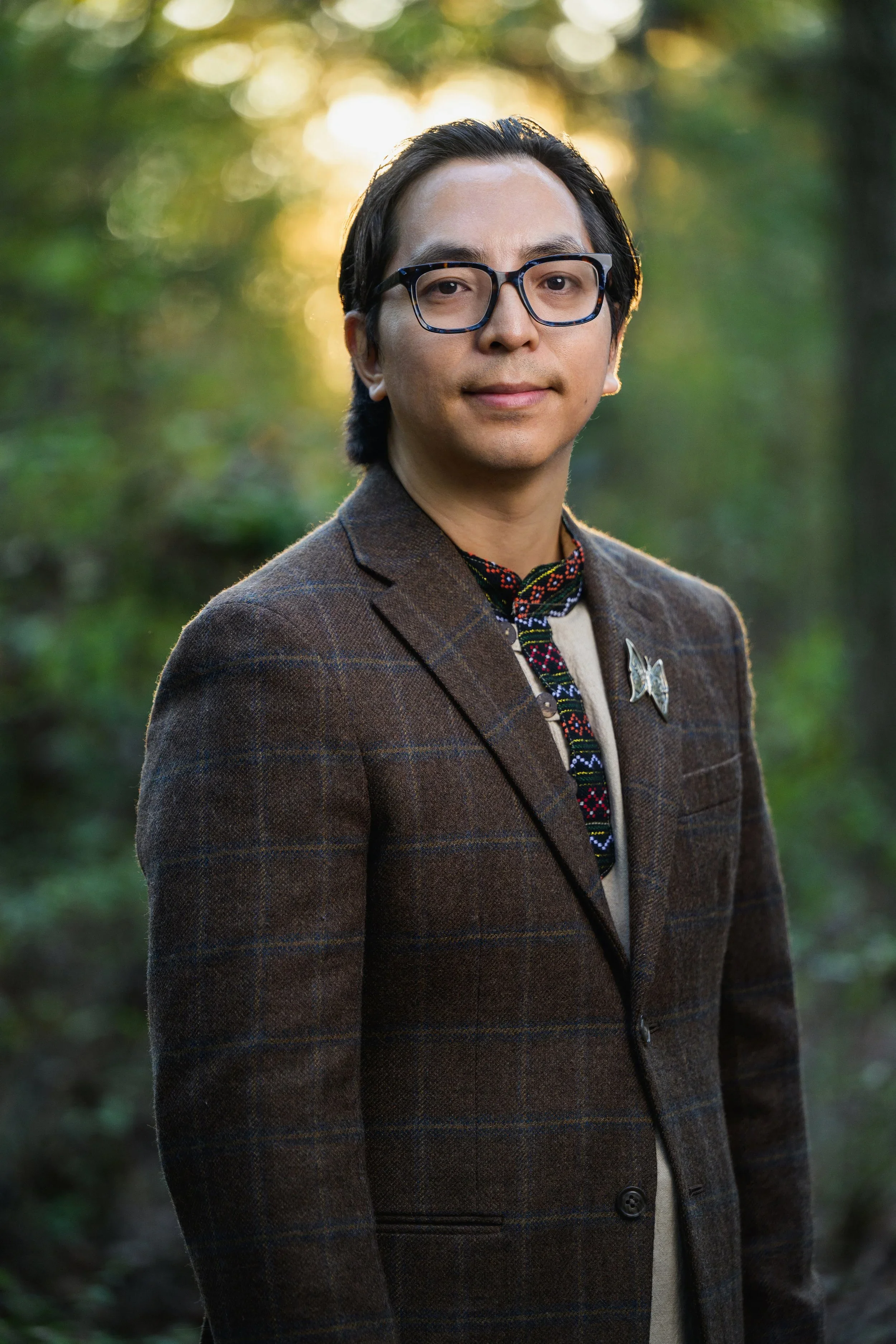
SAMYAK SHERTOK is the author of No Rhododendron (University of Pittsburgh Press, 2025), which was selected by Kimiko Hahn for the 2024 AWP Donald Hall Prize for Poetry and a finalist for the 2026 PEN Open Book Award. His poems appear in The Cincinnati Review, The Gettysburg Review, The Iowa Review, The Kenyon Review, POETRY, Shenandoah, Best New Poets, and elsewhere. A finalist for the National Poetry Series, the Agnes Lynch Starrett Poetry Prize, and the Jake Adam York Prize, he has received fellowships from Aspen Words, the Helene Wurlitzer Foundation, and the Fine Arts Work Center in Provincetown. His work has been awarded the Robert and Adele Schiff Award for Poetry, the Gulf Coast Prize in Poetry, and the Auburn Witness Poetry Prize. Originally from Nepal, he was the inaugural Hughes Fellow in Poetry at Southern Methodist University and currently teaches creative writing at Mississippi State University.
SHRANUP TANDUKAR is a poet from Lalitpur, Nepal. His writings have appeared in the Lucky Jefferson, Salamander magazine, and Riverstone Literary Journal among others.