
The Landlord
Derek Andersen
I.
The red-brick Victorian was pre-1871—that was as much as anyone knew. The deed had burnt to a crisp in the old city hall, one of the many clerical casualties of the Chicago Fire. Lloyd marveled at how claustrophobic the apartment felt, despite its twelve-foot ceilings. It was as if the landlord had sought to strip it of all the indefinable qualities that made a living space a home. He’d equipped each room with floodlights that emitted a harsh glare. He’d bricked up the fireplace and replaced it with a faux imitation. He’d walled in the back porch, transforming it into a “three-season room” that reeked of mildew. He’d barred the windows.
In the upstairs unit, the landlord paced in his thunderous work boots. His restless footsteps had become a fixture of the apartment’s soundscape, constant as the metallic whir of the heater. Of course, Lloyd had, with the utmost midwestern tact and politeness, sent a host of non-accusatory texts hinting at the issue, such as Hey, I hear some loud noises up there. Are you alright? and Sounds like you’ve got your work boots on again. Do you need help with anything? At this point, he’d told the landlord everything short of Take your fucking boots off, asshole.
Most of the time, the landlord ignored him. But when he did text back, he responded with unsettling non-sequiturs. The latest read, Do you see the white van parked across the street? When Lloyd told him it was just Comcast, the landlord replied, I know F.B.I. when I see it.
Unable to sleep, Lloyd spent the previous night poring over the online DSM-5. His armchair diagnosis was that the landlord suffered from paranoid personality disorder. The F.B.I. bit was standard fare: Persecutory delusions involving the F.B.I. are often manifestations of the individual’s anxieties about living in the modern surveillance state. The more he read, the more he feared what the landlord was capable of. When their delusional narratives are challenged, individuals with paranoid personality disorder can become viol—
“Do you like this sheepskin?” Lloyd’s girlfriend Maya asked, turning her laptop toward him. As a frequent overnight guest, she was determined to make the place less of a bummer.
“Looks nice.”
“Your place has good bones.” She surveyed the room. “It just needs a few accent pieces to bring it together.”
“Uh-huh…” Lloyd strummed his acoustic guitar idly, watching the gunwale clouds marshal together, sealing off the last sliver of blue sky. The footfalls upstairs grew deeper, more pronounced, rattling through his skull until they obscured all other thoughts.
II.
Lloyd peered down the block. It was uncharacteristically still, for the first snow of the season was underway. The serene white blanket had a quieting effect on the neighborhood, dampening the usual chatter. There was only the rumble of the occasional plow passing through, heaping snowbanks onto the curb. Satisfied the coast was clear, he sparked a cigarette.
At Maya’s behest, Lloyd had quit smoking months ago. Lately, though, he’d felt the itch to light up again. After leaving his job to pursue music full time, he’d become ensnared in the shackles of writer’s block. He hadn’t written a song—or even a riff—in weeks. He blamed the landlord’s footsteps for stunting his concentration. He took a long, soothing drag and leaned against the building, batting around a new lyric. Out here, thank God, he could hear himself think.
The rasp of a snow shovel derailed his train of thought. A few doors down, in a Chicago worker’s cottage, an old man struggled against the snow on his front steps. He cleared a small dusting at a time, clutching his aching back between strokes. As he descended the stairs, he slipped—he would’ve faceplanted, had he not managed to snag the railing.
Lloyd snuffed out his cigarette and trudged over. “Need some help?” he asked.
“Oh, that would be lovely. You wouldn’t mind?” the old man said.
Lloyd shoveled the steps with ease, whistling while he worked. It reminded him of clearing the driveway for his grandfather when he was a boy. The old man even bore a passing resemblance to his late Pop-Pop with his kindly blue eyes and nose full of broken capillaries. In all of five minutes, Lloyd was finished. He sprinkled on some salt for good measure.
“Can I invite you in for some coffee?” the man asked. His green door stood ajar, giving Lloyd a glimpse of the sanctuary inside—the hanging vines, the family photos, the crackling fireplace. It looked like paradise compared to his dreary apartment.
“That’s really kind of you, but I need to get back,” Lloyd said. He’d just untangled the lyric he’d been working through and was eager to commit it to paper.
The old man introduced himself as Henry and asked where Lloyd lived. When Lloyd pointed at his building, the old man’s face darkened. “If that creep tries any funny business, you know where to find me,” he said. Lloyd chuckled, thinking this was a joke, but Henry’s face showed no signs of mirth.
When Lloyd returned to the apartment, he cracked open his moleskin notebook, but the lyric escaped him, drowned out by the cacophony of footsteps.
III.
On the front stoop, amid bitter gusts of Lake Michigan wind, Lloyd fumbled for his keys. His numb fingertips made matters difficult enough, but he also had to perform the search beneath the accusatory red eyes of two security cameras. He could feel the landlord’s gaze through the lenses, corneas boring into him.
At last snagging the keyring from the depths of his backpack, he flung the door open and lurched inside. “I’m home,” he said.
“In here,” Maya called from the kitchen.
“How was work?”
“Have I got a story for you!” She dispensed some water from the Ice Mountain jug on the counter. “So, Tessa asks me to go through the Mercer reports for—”
“Wait, what’s with the water jug?”
“Oh, the landlord left it here. He ordered one of those free test kits from the city. Turns out you have trace amounts of lead in your pipes.” She raised the glass to her lips.
Before she could take a sip, Lloyd slapped it from her hand, sending it shattering to the floor.
“What the hell?” Maya said.
In one violent motion, Lloyd hoisted the jug and began emptying it into the sink. “We’re not accepting anything the landlord gives us. You hear me?”
“Why?”
“The man’s a lunatic.”
“He’s a little off,” she conceded. “But the water jug was a nice gesture.”
“Let me ask you something: Did you see these alleged test results?”
“Well, no.”
“Did you pause to consider why he didn’t leave the jug in the front hall, instead of entering the apartment without my permission?”
“He just saved you some legwork. The thing was pretty heavy—you saw.”
“Don’t you get it? Now, he has an excuse to sneak into my apartment every week and snoop!”
“You’re incredible. Sure, maybe this man has a paranoia disorder—that’s very possible. But the fact is, he did us a favor.” She snagged a beer from the fridge and cracked it. “He has no one in his life except for that little rat dog of his, for Chrissake. Can’t you just let him have this?”
“We’re buying a filter.”
For a moment, they stared at the glass shards embedded in the new Persian rug Maya bought him. Only the final wounded glugs of the water jug dared to break the silence.
IV.
On December twenty-fifth, there were no chestnuts roasting over the faux fireplace. There was no heat, no crackling, only a sickly orange glow. Two sweaters sat at the foot of the Christmas tree. A pair of silk boxers cloaked the three wise men. The Polar Express circled the tracks with a bra in tow, making none of its scheduled stops.
“I’m sorry,” Lloyd said, slinging his legs over the edge of the couch.
“Did I do something wrong?” Maya asked.
“Not at all. It’s these new meds I’m on.”
“Really?”
“I promise.”
From the corner of his eye, Lloyd caught the flash of a red light. He rose from the couch and crept toward it. In truth, it wasn’t his medication that had stymied his performance. It was the nagging feeling that he was being watched. That his every move was being surveilled and dissected by the landlord.
Lloyd drew his muscles taught, waiting for the light to reveal itself again. With the next blink, he triangulated its position. He tiptoed closer. Aha! He threw back the garland. But behind it, there was no camera. It was only the nose of a kitschy Rudolph decoration.
V.
“Come on, you have to tell him your heater’s broken,” Maya said, wrapping herself in a cocoon of blankets.
“And give him an excuse to waltz in here? No way.”
“Lloyd, I can see my fucking breath.”
Lloyd was about to fire back at her for hyperbole, but he stopped short when he saw his own breath escape in a ghastly fog.
Upstairs, the footsteps had been replaced by a strange new sound. By Lloyd’s estimation, it was either a drawer opening or an office chair rolling across the floor. Each time Lloyd relaxed and let down his guard, the sound returned with grim inevitability.
“You can’t let the pipes freeze.” She rubbed her mitten-clad hands together. “Let me text him.”
Before Lloyd could say another word, he heard the text go out on Maya’s phone. She’d gotten the landlord’s number from Lloyd a few weeks back—he was out of town, and she needed to oversee some repairmen.
Almost instantly, her phone pinged. “Maya, thank you for bringing that to my attention. I can tackle it first thing tomorrow morning,” she read. “Look, he even used a smiley face emoji.”
Lloyd couldn’t help but notice the promptness and coherence with which the landlord responded to Maya. By contrast, the text he’d received from the landlord that morning read, Being the listing agent for the gun shop building in Long Beach was Obama’s rationalization for having me gangstalked across the USA by the FBI. The Patriot Act gave him too much power!!
Nor could Lloyd reconcile the smiley face, a character conspicuously absent from the landlord’s communications with him. On one hand, the landlord was a boomer and couldn’t be expected to understand the subtext of emojis. On the other, wasn’t a smiley face a tad familiar for their relationship? She wasn’t officially a tenant—just a frequent guest.
Maya’s phone pinged again.
“Was that him?” Lloyd asked.
“Uh, no.”
“Maya, I saw his name pop up. What did he say?”
“Nothing.”
“Come on.” Lloyd reached for her phone.
“Really, it’s no big deal. He gets lonely up there sometimes and wants to chat. I play along for both our sakes—we have to stay in his good graces.” She pulled away from him.
Lloyd grabbed her wrist and wrested the phone from her. “Did you notice Lloyd’s picked up smoking again?” he read. He dropped the phone on the couch beside a panting Maya. “He’s keeping tabs on me?” Lloyd’s eyes turned glassy, distant.
“Occasionally, he gives me updates on your day-to-day affairs,” she said, massaging his shoulders. “But I just ignore them.”
“What else have you two been talking about behind my back?!” He pulled away.
“Nothing, I swear!”
“Prove it.” He held his palm out.
Upstairs, the new sound crescendoed into a deafening roar. The landlord’s English toy spaniel joined the cacophony, yelps seething with ten generations of inbred rage.
“I’m not letting you snoop through my phone.” Her gaze hardened. “Do you know who you sound like right now?”
As if on cue, the landlord fell eerily still. A vicious gust rattled the storm windows, cutting through Lloyd like a razor blade.
VI.
“I can feel his paranoia hanging in the air like a pathogen. I can feel the delusions swelling in my brain like malignant tumors. Kevin, I can’t tell what’s real anymore. It’s as if that little two-unit has the power to warp the contours of reality.”
“Uh-huh,” Kevin said, studying the lease. Lloyd had come to visit him at his office in the suburbs, a three-story cubicle farm overlooking a sad little retention pond.
“As I lay in bed last night, a thought whispered itself into existence.” Lloyd wheeled a chair over and sat down. “On first inspection, it was a cowardly, selfish thought.” He leaned in. “But the more I tried to block it out, the louder it rasped. Do you know what it was saying?”
“What?” Kevin looked up for the first time.
“Escape.”
Kevin set the document aside, sighing. “You came here for my professional opinion, right?”
“That’s correct.”
“I have to qualify this by saying my area is corporate law.”
“Of course.”
“But bearing in mind what you’ve told me, you have no grounds to break this lease.”
“That’s preposterous! Did you hear a word I said?”
“I did.” Kevin removed his glasses and pinched the bridge of his nose. The gesture felt a tad dramatic coming from a junior associate. “However, your landlord being ‘crazy’—even if you could prove it in court—doesn’t violate any of Cook County’s landlord-tenant laws.”
“But he entered my unit without my permission! He violated the lease!”
“Do you have tangible evidence of this?”
Lloyd opened his mouth, then thought better of it.
“Look, my advice is to hold tight. Your landlord sounds like the vindictive type. Should you break the lease, I’m sure he wouldn’t hesitate to sue you for damages. As a working musician, do you have the money to fight that right now? Then there’s the issue of where you’re going to stay. It sounds like you and Maya are on the rocks, and good luck renting another apartment with a broken lease on your record.” Kevin offered the document back to Lloyd. “I’m sorry, man. I wish I could find a loophole, but for the time being, you’re trapped.”
Lloyd snatched the document from Kevin’s outstretched hand and, without so much as a thank-you-for-your-professional-opinion, stormed out to the parking lot. Flicking his cheap gas station lighter to life, he set it ablaze. But this did not make him feel powerful. Despite the destruction of the paper, the agreement remained. He was indelibly bound to the landlord.
VII.
The landlord’s latest text, a response to a question about a missing Amazon package, chilled Lloyd to the bone. The Day of Reckoning is near!! I have made it my Holy Mission to stop Monsanto from poisoning humanity. No one, not even the FBI, will silence me!!!
On his way to the shared laundry room, Lloyd tried to unpack the new religious element of the landlord’s delusional narrative. Did he believe he was some kind of messiah figure? What was this impending “Day of reck—”
Lloyd halted. Through the cracked laundry room door, he spied the silhouette of the landlord. He was dressed in a dusty hoodie, paint-spattered jeans, and his oversized work boots. His flesh was ghoulishly pale and, despite being indoors, he wore a pair of oversized sunglasses. To Lloyd, he looked like an apparition—a restless specter haunting the grounds.
Spellbound, Lloyd watched the landlord reach into his dirty laundry hamper. It all seemed to happen in slow motion: he dug out a pair of Maya’s panties—the lacey purple ones that sat high on her waist. He massaged them between his fingertips, a twisted grin spreading across his pallid face. With a sickening smack, he licked his lips. He raised the panties to his nostrils and inhaled deeply, moaning in ecstasy. As the landlord slipped his hand into his jeans, a spurt of adrenaline, at last, broke Lloyd from his trance.
Lloyd darted for the back door, goosebumps prickling the back of his neck. Just before he could grab the knob, he stepped on a creaky floorboard. Behind him, he heard the landlord start. Heart thudding against his sternum, Lloyd flung the door open and staggered into the frigid February night.
VIII.
From the safety of a shadowy alley, Lloyd scoped the block. Two stragglers shared a cigarette outside Map Room, their inebriated cackles echoing off the façades of the red brick buildings. A nightshift nurse’s grocery bag ruptured, sending a two-liter bottle undulating down the sidewalk. An unmarked white van peeled out, taillights fading into the night like a distant dream. And then all was still.
Lloyd stole across the street, apartment key in hand. As he stepped onto the curb, a patch of black ice whipped his legs from under him. He tried to brace the impact with his left hand, but his wrist gave way with a sickening crack. Yelping in pain, he watched his blood pool on the asphalt. A car whizzed past, inches from his face. But the driver couldn’t be bothered to stop. He just blared the horn.
When Lloyd, at last, coaxed his body into a sitting position, there was the landlord standing over him. “Maya and I know what you did,” he said.
“W-what are you talking about?”
“In the laundry room.” The landlord’s face darkened.
Despite himself, Lloyd began to tremble before this motherfucker—this scrawny quinquagenarian holding an English toy spaniel in tow. The air between them was charged, distorted by the murderous energy of the landlord’s delusions. Lloyd felt like a trapped animal, limbs going numb on the cold concrete. With all the defiance he could muster, he said, “Come again?”
“We know you cut the washing machine line. No one else has access.” Even behind his sunglasses, Lloyd could make out his wide, manic eyes.
“Why would I vandalize my own washing machine?”
“You tell me.” The landlord pulled up his hood and strode off down the block.
IX.
Lloyd rapped on the familiar green door, duffel bag slung over his shoulder. For a moment, there was no reply—only the lonely wail of the wind. As he weathered the brisk, single-digit night, grasping hand warmers that had long ago fizzled out, he began to reconsider his plan. Was he imposing, he wondered, showing up here unannounced?
Just as he was about to turn back, the door swung open. “Lloyd, what a nice surprise! You must be freezing. Please, come in,” Henry said. He took Lloyd’s coat and ushered him into the living room. Lloyd sat cross-legged before the roaring fireplace and warmed his icy digits. Henry proffered a mug of chamomile tea and Lloyd accepted, taking a long, contented sip.
Lloyd explained everything to Henry, how the landlord had gotten to Maya first and shaped the narrative, decrying Lloyd as a scheming vandal. How Maya had sided with him, chastising Lloyd for harassing a poor, mentally ill man. How Lloyd had tried to defend himself, but when he detailed the vast conspiracy against him, he came off as unstable, to say the least. How Maya, fearing for her safety, had jetted off, leaving the apartment more desolate than ever.
“That man is a duplicitous little worm,” Henry said, staring into the fire, shadows playing on his face. “When my daughter was in high school, he used to strike up conversations with her at the dog park. He was perfectly polite, chatting about the weather and whatnot, but she could tell something was off. Then one night, after everyone else went home, she felt something on her shoulder. She turned around and there he was snipping off a lock of her hair.”
An unsettled silence fell between them. Henry opened a bottle of Scotch and steered the conversation to greener pastures. He told Lloyd he’d lived in this house all his life. Though he had an illustrious career as a journalist for the Tribune, his real dream was to write his great American novel. He just never seemed to have the time. Now that he was retired and had all the time in the world, the thought of putting pen to paper paralyzed him. Lloyd shared his songwriting struggles, and they cheersed to the joys of writer’s block.
When midnight rolled around, Henry led Lloyd to his daughter’s old bedroom down the hall. He told Lloyd he could stay as long as he liked; it would be nice to have company. Lloyd changed into his pajamas, marveling at how cozy the space was—moonlight shone through the bay window, leather-bound books lined the walls, a cat made biscuits at the foot of the bed.
When Lloyd opened the closet to stow his duffel bag, he noticed something amiss. It was empty, save for a black hoodie that read “Lane Tech Football 2016.” Why would his daughter have a men’s hoodie in her closet? Lloyd supposed it could be a memento from a past boyfriend, but why hold onto it? Especially since all other signs of her had been wiped from the room, replaced with beige paint and unisex bedding. Lloyd spied an issue of the Sun-Times on the dresser. If Henry worked for the Tribune, why subscribe to its rival paper? Didn’t they have some kind of journalistic bad blood? Footsteps creaked outside the door. These weren’t the thunderous footsteps of the landlord—these were stealthier, more calculated. A chill ran down Lloyd’s spine as he realized he didn’t know a thing about Henry other than what the old man had told him. What if his whole backstory had been a lie, a ploy to gain Lloyd’s trust? What if the hoodie belonged to the last young man who had fallen into his clutches? Lloyd’s stomach gurgled, and he became acutely aware of the various beverages the old man had foisted on him. What if his plot was already in motion? Claustrophobia gripped him; he no longer felt cozy, but caged in. He quickly redressed and snuck out the window.
X.
When Lloyd returned to the two-unit, he felt an immediate kinship with the place. The kitchen burner that didn’t light; the crack in the bathroom sink resembling a long, dirty hair; the multiple, conflicting switches for the same light fixtures; the line on the floor where the old stain color met the not-quite-right new stain color; the showerhead that shrieked like a banshee—all these little quirks had become part of him. This 800-square-foot apartment was the closest thing he had to a home. He was struck by the absurdity of escape plan—who was he to think he belonged anywhere else? Laughing maniacally, he went out back and grabbed the two-by-fours he’d spied by the dumpster. Noise ordinances be damned, he nailed them to the doors, barricading himself inside the apartment. He huddled beside the faux flames and, for the first time all winter, he could feel their warmth.
DEREK ANDERSEN is an Illinois Wesleyan alum working as a copywriter in Chicago. His short stories have appeared in Arts & Letters, Barrelhouse, Catapult, Columbia Journal, and elsewhere. His piece “Napalm” was named a notable Best American Short Story of 2022. Read more of his work at derekandersenwriting.com.
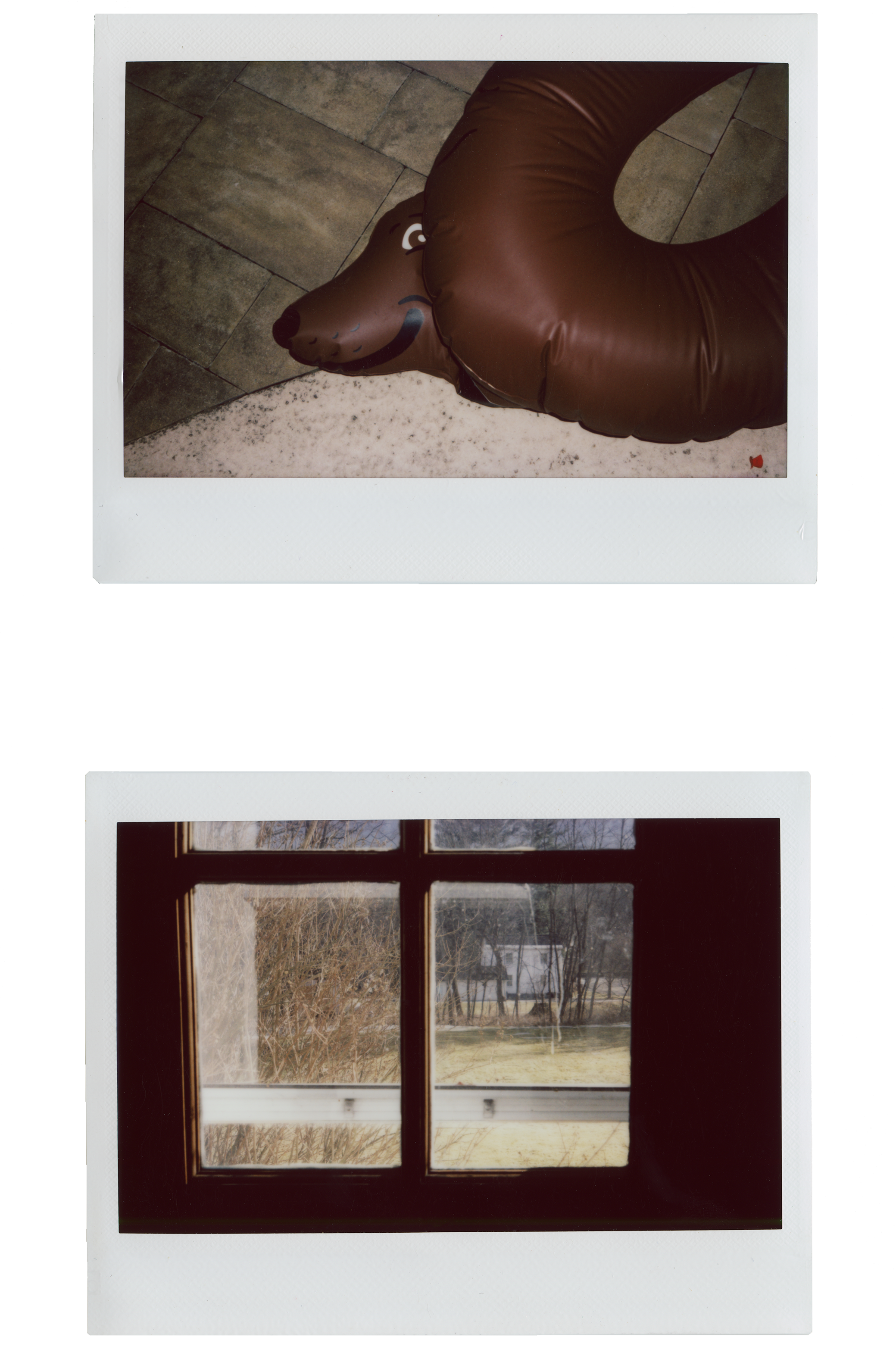
The art that appears alongside this piece is by GARRETT FULLER.